Slopes
Members
-
Joined
-
Last visited
Everything posted by Slopes
-
D8ve - a straight swingarm would be much easier the build - although it would still have to splay from the narrow pivot and out around the wheel.
-
OK - I get it now. Thanks everybody... back to the drawingboard.
-
But aren't the hub and the wheel all of a single piece? The centre point of the torque is where the axle tries to spin in correspondence with the rest of the moving wheel (in a clockwise direction according to my diagram), but is prevented from doing so by it being fixed to the static dropout. This places a clockwise - downward - force onto the resisting dropout which spreads up into the arm it is attached to. This creates an 'extending' force on the rod (it tries to stretch out the rod).
-
This is what I struggle to understand, d8veh. I can see that if torque was caused by the backward movement of the bike (if the motor was in reverse), the rod would be forced to compress (and thereby bend or bow). But it seems to me, with the forward movement of the bike the anchored rod would be forced to extend (which, of course, it would resist). This is what I try to illustrate with my diagram.
-
Slimjim. The dropouts are exactly as shown in the photo I pasted up a page or so back (in fact that's my frame). The width of each dropout is 8.3mm. From my understanding, the forward motion of the wheel will place a downward force on the swingarm - as shown in my diagram below. The area shaded in pink is where the item may be susceptible without reinforcement... ie, if the swingarm was made of (say) nylon, this is where it would bow downwards in response to the motor's driving force. I think the rod (in red) would take the torque strain away from the arm itself. The vertical positioning of the back end of the rod may be determined by where it would avoid coming into contact with the chain. http://i64.tinypic.com/29wq3av.jpg
-
I don't disagree with you, d8veh (and I certainly respect your opinion). It's just that I like setting myself design challenges and thinking through ways to make them succeed (elegantly, if possible). The good news is the Xiongda website is back online :-)
-
Yup, I haven't got any of the crank/chain mechanisms attached yet, so I'm not sure if a rod would get in the way of this. I could just fit it to one arm (the non-chain arm), but that might not be effective. EDIT: The function of the rod would only be to take away (or reduce) downward, vertical torque pressure from the length of the CF arm. It would have no effect on any non-vertical torque - which I think will be no greater than it would have traditionally been on the non-mototised bike. So, although the rod needs to be stiff, lengthwise, I don't think it would have to be rigid in the sense of a being a structurally fixed part of the member.
-
Thanks for your considered response Slimjim. You raise some valuable points. To eliminate any 'counter tension' a taught cable might cause to the swingarm, maybe a 2mm steel rod (think coat-hanger wire) would work better instead. This could be attached in either of the ways shown in my image. The second shows an additional tension arm fixed to the dropout - although I think it's not required and the first design would work best. http://i68.tinypic.com/25kmng6.jpg
-
Yes I will be very careful - and I may well sort out an alu arm once I've completed this conversion to a working bike. I understand the issue here and I think a possible solution might be to run a tight 1mm steel cable from the back wheel axle down to the axle for the swingarm... this would transfer much of the motor's 'pull' away from the arm itself and back to the frame of the bike - whilst not inhibiting any movement of the rear end suspension.
-
I have the frame now- looks in great condition... barely used, if at all I've decided to keep and use the carbon swingarm for the time being - as rebuilding the item in alu will be time-consuming and tricky - with its various angles. I'm not intending to use the bike off-road at the moment so I can gently test out the existing backend with the motor fitted. The dropout gap is 135mm - as bending the arms is out of the question, I'll opt for a version of the Xiongda hub at that width. Presumably, if I'm limiting myself to a single gear at the back, I could fit in a disc brake too (?)... if not, I'm ok with a V brake on the back with a disc on the front forks. The Xiongda website appears to be down currently so I do hope they haven't gone out of business (has anyone had any recent dealings with them?). I also note that Panda Bikes has stopped selling this product - which is a shame as I was very templed to buy the whole kit from them. I have to decide upon 36v or 48v. I definitely want to keep within the 250w legal limit, but also want the best performance I can get - any help with a good overall set-up would be welcome.
-
Well, a friend has a TIG but to be sure, I might ask in the local cycle shop if they can weld alu. If I go with rectangular box tube, I can ask the supplier to cut pieces to the dimensions I supply - or cut them here on my mitre saw. As for the initial design, I'm pretty good with Fusion 360... so I'll start by making a precision drawing of the new swingarm, taking measurements from the old CF one (once the frame actually gets delivered!).
-
chris_n... that sounds like a good solution, but I think it'd be beyond my abilities - would like to keep the welding I'll have to do to a minimum.
-
So far it's shaping up to be very cost effective. And - from a design point of view - I like the look of the bike... it's one of a few from that era that lends itself to conversion (CF swingarm notwithstanding).
-
trex - is there anything I could do to prevent this happening? Such as raising the height of the shock mount to its original position and welding the two arms together with a hefty central 'shoulder'?
-
A straight swing arm in the rectangular tube would be the easier option (and the preferred one in terms of my metalworking abilities). Although I'm not sure if a straight tube would clear the crank/BB.
-
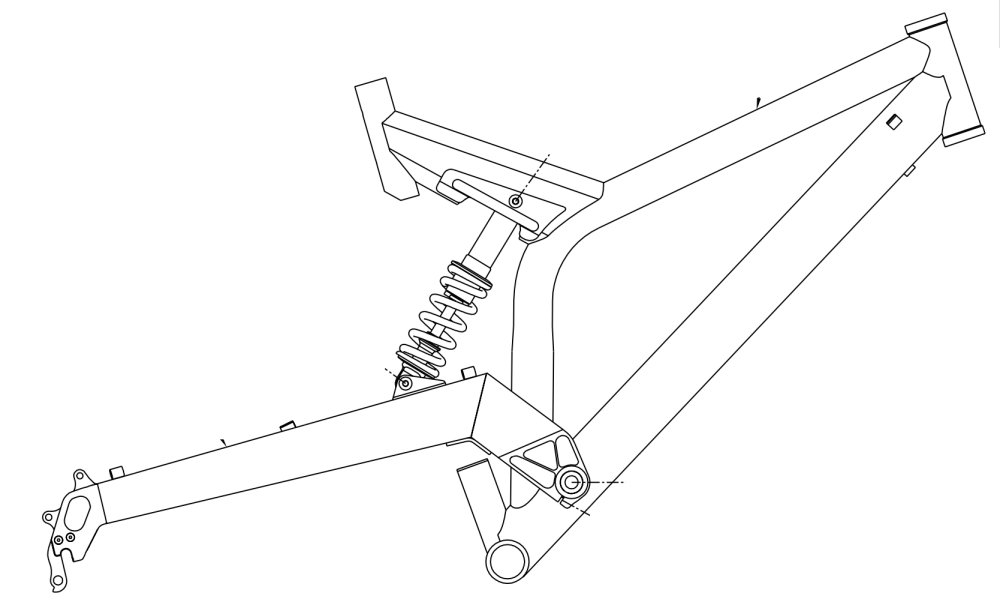
Here's a technical drawing I found of the K2 (which has been very useful for planning out) and I'd like to shape the swing arm as closely as I can to its original shape. That's not gonna be entirely possible with rectangular tubes - and I suppose I could build the arm as a frame of round tubes (following the contours of the original) and weld a tapering 3mm flat plate onto each side. I've seen pictures of the same K2 bike with an alu swingarm (obvious from the weld lines)... maybe Proflex brought this out to deal with cracking problems in the CF version?
-
Top drive - yes, I can see the point you're making. Even though the rear axle will essentially be a single gear, its arc (from the chain crank) will still diverge from the arc of the swing arm as suspension is brought into play. It therefore seems likely I will require some form of chain tensioner to compensate for the small difference this will cause. Thanks for mentioning this.
-
Thanks guys. I've been looking at some alu rectangular tube - 6063T6. I'm thinking maybe 80mm x 20mm with a 2mm wall. I'll weld some horizontal dropouts onto these (for wheel adjustment to take up chain slack) and work out what's needed for torque and disc brakes (I've heard there is a conversion kit for older bikes with only V brake mounts). The good news is my frame is now in the country... although I've just discovered I'll have to pay duty on it ...I always believed second hand goods were exempt. Asked in my local bike shop today about lacing a rear rim with motor hub... they said it's no problem and they'll do it for £35 - which seems like a very good price to me.
-
Again, great advice, thanks. I would, of course, reinforce both arms, equally, to balance things up. Another thought I've had is to get the swingarm remade in alu... maybe CNCed from (say) flat 12mm plate to the contours of the existing item and then welded. The frame is currently on the way to me from the U.S... so I've nothing but photos and technical drawings to look at.
-
Thanks, Slimjim - very useful advice. I was actually thinking of wetting on a couple more layers of CF to the swingarm to give it more strength. If this is possible, I could - at the same time - bond on an alu plate for the torque arm... as well as add whatever is required to fit a disc brake. As there will be no cassette, I think I'll have plenty of room for these additions. Do you think this would work?
-
OK - on further research, this bike did come with 26” wheels. But I think I’ll stick with my original plan to place 24 inchers on my frame. To keep the BB away from the floor, I’ll extend the length of the front forks - thereby raising the front end and tilting the frame back a little. I am concerned about the carbon fibre back end with a rear mounted hub. But I’ve found a couple of e-bike frames using this material for swingarms on back mounted hubs… so it's certainly doable. My worry here is more with torque and slippage on the axle - and where to place a torque arm (if needed) without it overly stressing the CF.
-
26" - you are right (I only have the frame so far, which looks more or less as-new). I'll stay with the wheel size originally intended for this bike. The carbon rear end was one reason (along with internal gearing) for considering a front mounted Xiongda. Although I weigh around 168lb so I don't think a rear mounted hub would place any extra stress on the arms under normal road use.
-
Thanks for the replies - much appreciated. Some more info... I’ve always liked the simplicity, input requirements and overall appearance of a three gear internal hub. On my previous 3-speeders, I spent most of my time cycling around town in the high gear - shifting down only for hills where I couldn't build up enough momentum to get me to the top. I now have a Proflex K2 frame to convert - which takes a 24" wheel. This has a carbon swingarm at the back, so weight may possibly be an issue with a rear mounted Xiongda - although it seems to be a relatively light motor. This would be my preferred position (the battery will go into the frame triangle, either way). I read through the long Endless Sphere thread on this motor yesterday and a guy there enquired about building a single-speeder with a rear mounted Xiongda hub. This is closest to what I’m looking for - but I’d like the option of an extra gear to use. Would it be possible to have a single-speed, rear hub arrangement like his but with a 'Metropolis 2-Speed PT crankset' … effectively providing four gears? I was intending to play safe with a 36v set up, but may go to 48v if it’s noticeably more torquey (I got the impression from the ES thread that there wasn’t that much of a difference). The bike will mostly be used on the road - with very occasion trips along easy dirt footpaths/fields, etc.
-
Hi everyone - a newbie here. I used to cycle quite a bit but not so much these days due to slightly gamy knee and having my (somewhat neglected) bike nicked a couple of years ago. I've spent the last two weeks totally immersing myself in the possibilities of ebikes and would like to make one. After reading about (but not necessarily understanding) all the various options, I've arrived at an ideal set-up I would most like to build. I wonder if anyone can comment on whether or not it is doable/sensible/legal? My planned build is: 1) Old DH mountain bike (24" wheels) 2) Xiongda 36V/250w 2-speed hub (front mounted) + 36V lithium battery 3) 3-speed internal hub to back wheel (I don't want derailleur gears) My intended use is zipping round town (with its various hills) and the occasional (very mild) off-roading. In either situation, it'd be great to feel a bit of extra 'oomph' and that it was fun to ride. From the various threads I've read, I understand that Xiongda are quite happy to adapt a motor and mark it with the above specifications... and that would certainly be considered if it provided a reasonable amount of power to make the investment seem worthwhile... but I don't know enough to confidently give them a specification for this. Advice from experienced ebikers - and Xiongda users - would be very much appreciated...
-
(Reposted in 'conversion' thread...)