


Leaderboard


Popular Content
Showing content with the highest reputation since 18/04/26 in all areas
-
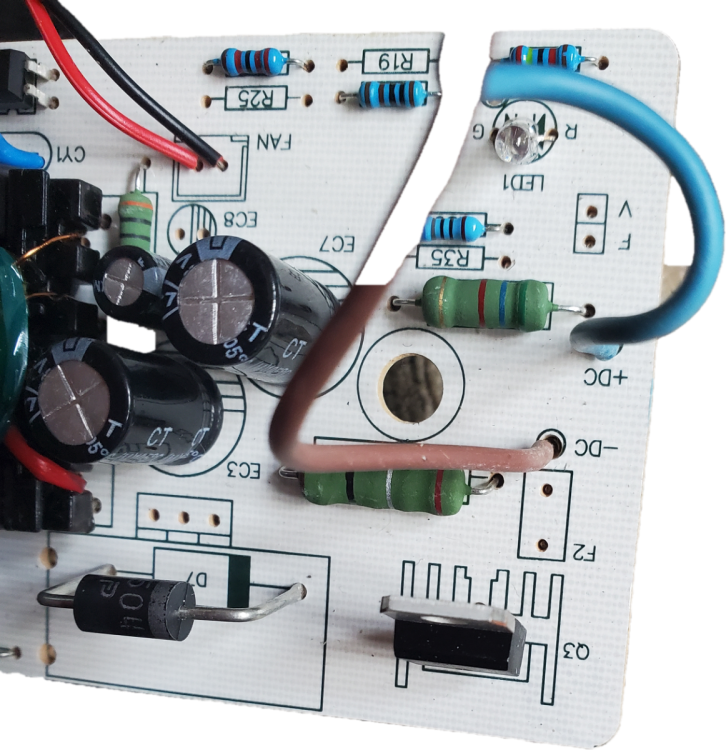
3 pointsI wanted to borrow the lead from the last charger I got. When I opened it up, this is what I found. The wire colours are reversed. I mentioned a few days ago that it's quite common, but I thought maybe it's an old problem. Clearly, they're still doing it. It seems to be the rule rather than the exception. Be careful if you ever have to change a lead or connector on a charger. Always use a meter to check. Disregard any markings or colours.
 3 points
 -
I don't know whether everybody realises, but heavy people need proportionally more power to get up the same hills as you. In other words, If you weigh 70kg and have a 36v bike with 15A controller, a 110kg guy would need 48v and 17A to get up the same hill on the same bike with the same effort as you. If the 70kg rider rode the bike with 48v and 17A, it would feel ridiculously powerful, like a motorbike, but the 110kg rider's experience of that bike would be more or less identical to the 70kg rider's experience on the 36v one.3 points
-
2 pointsYou can't go wrong with a bike from Woosh or Wisper. Choose hub drive, cadence sensor, biggest battery you can afford. Easy.2 points
-
It's not the sensor that was the problem. Many/most of the OEM bikes and kits at the middle and lower end of the price scale use crappy speed control controllers that don't give you control over how much power they give. You can solve that by swapping the controller for a power control one, then you have the best choice of how much pedal effort you want to give and how much power the motor will give independently. If you want a power control controller, search for "KT controller", also known as Kunteng with various spellings. They have another advantage that you can fit a boost button that gives instant max power rather than going up and down the levels each time you come to a hump-back bridge or want max power to get you through a busy junction.2 points
-
I’m another satisfied with the maximum the 250W continuous power law. I never feel my bike is underpowered, for example as a teenager I needed to stand on the peddles in first gear out of breath to crawl over the hill into town. Now in my 70s I can use full power at 12.5 to ,13 mph seated over the same hill. Yes I’m out of breath but not as much as I used to be. I could buy a moped and go faster but then I’d loose the freedoms of a bicycle, especially the use of the new cycle path that feels so good being separated from the increasingly dense traffic. 250W and bicycle rules are just right in my opinion.2 points
-
2 pointsCATL says sodium batteries are mainstream-ready, signs massive 60 GWh dealhttps://electrek.co/2026/04/27/catl-sodium-ion-battery-60gwh-energy-storage-deal/2 points
-
Least bad would be correct, or least terrible, least frightening, least dreadful or something like that. Good, better, best; bad, worse, worst. More bad = worse, most bad = worst. By definition, if Labour is the worst, they can't be better than the others. The language is changing all the time, so it's sort of acceptable to say that. Many people don't use English correctly, e.g. in response to "How are you?", "I'm good" is often used. I'm good means well-behaved, not in good health, but so many people use the phrase now that it's accepted as correct, though it doesn't mean that it is. The correct response should be, "I'm well". In business language, "I'm good" is now given as a suitable response. "How's it going?": "It's going well". Nothing can go good, except in computer games where the need to improve is expressed as "git gud".2 points
-
It's better now; however, you don't make clear the differences between a front and rear hub-motor. Reading what you wrote, and if I didn't know anything, I'd select a front motor. I don't agree with the statement about front motors being easier to install. Cable routing is harder. You have to file the dropouts of Q/R wheels. A rear 7-speed freewheel motor nearly always drops straight in. You need to make the advantages and disadvantages clearer. Also, you need to mention about the problem of axle slip with crank-drives and horizontal drop-outs. These are some points people need to consider when making the motor type choice: Front Hub-motor You have to file the drop-outs if you have a QR wheel The danger of drop-outs breaking or motor spin-out sending you over the handlebars The need for steel forks for any medium/high torque motor The additional inertia can upset the handling The added mass will compromise the suspension The motor cable has to deal with steering. Traction can be bad on loose surface or in low grip situations Higher noise from the motor Very reliable (apart from drop-out issues if not done properly) Rear Hub-motor The problem of offset that limits gears to 7 speed with a freewheel motor and is worse with most cassette motors. It's safer than front motor. Better traction Lower noise Doesn't compromise suspension forks Easier cable routing Better steering Very reliable The difficulties of wheel insertion/removal when you have horizontal drop-outs Crank-motor Under-gearing on bikes with small wheels Axle slip with horizontal and angled drop-outs More efficient for towing and steep hills with heavy loads. Higher transmission wear More gear-shifting than hub-motors Coarser ride Better weight distribution Doesn't affect front or rear suspension Noisier than rear hub-motor Less reliable than hub-motors Mostly easier to install than hub-motors2 points
-
German Ebay normally has plenty or cheap new replacements.2 points
-
Have We Overestimated the Probability of Alien Life in the Universe? Once I grasped the sheer number of stars and galaxies in the universe, it seemed almost inevitable that life must be common. It was easy to imagine that the “little green men” of science fiction—or perhaps something larger and more menacing—might inhabit planets orbiting countless stars. Looking up at the night sky felt like looking at a vast collection of potential civilisations we might one day communicate with. It’s an appealing idea. But is it realistic? How likely is it that alien life exists on planets orbiting the stars we can see with the naked eye? My partner, an optimistic soul, dismisses my doubts. To her, it’s simply a numbers game. The Milky Way alone contains roughly 400 billion stars, so it seems unlikely that our Sun and its planets are anything special. I understand that argument. Statistically, it feels improbable that we are unique. But that intuition may be misleading. If very specific conditions are required for life to begin, for it to persist, and for it to evolve into complex, intelligent forms capable of building technological civilisations, then rarity—not abundance—may be the more realistic conclusion. It is extraordinarily difficult for simple life to evolve into complex organisms such as animals. It is even rarer for those organisms to develop behaviours that extend beyond survival—beyond eating and reproducing—towards intelligence, culture, and technology. And it is harder still for a species like Homo sapiens to progress from hunter-gatherers to builders of machines capable of exploring or communicating across the stars. Our own history makes this clear: it took nearly 300,000 years for our species to reach that point. Why emphasise how difficult these steps are? Because Earth’s history demonstrates just how long and improbable they appear to be. The Earth formed around 4.5 billion years ago as a molten, hostile world, battered by collisions during the chaotic early solar system. A massive impact—likely with a Mars-sized body—created the Moon and left the young Earth a seething, molten sphere. It took millions of years to cool. Nearly a billion years later, life emerged. Not animals, but simple single-celled organisms—algae, slime-like colonies, and microscopic cells drifting in the oceans. For roughly two to two-and-a-half billion years, life on Earth remained single-celled. Then, in what appears to have been a singular event, complexity arose. One cell engulfed another and, instead of digesting it, formed a symbiotic relationship. This partnership—an evolutionary breakthrough—gave rise to more complex cells. It happened, as far as we can tell, only once. From that point, evolution continued its slow work. Yet it was not until about 500 million years ago—four billion years after Earth formed—that plants first colonised land. Animals followed tens of millions of years later. And humans? We arrived astonishingly late: roughly 4.4 billion years after the planet formed. We are newcomers on an ancient world. Even then, technological civilisation is a very recent development. The first crude steam engine appeared in 1712, improved later by James Watt. Radio communication dates back only about 130 years, to experiments by Guglielmo Marconi—a blink of an eye compared to Earth’s 4.5-billion-year history. All this suggests that the path from chemistry to intelligent, technological life is not straightforward. It is long, fragile, and contingent on many unlikely steps. Even on Earth, only one species out of millions has developed advanced technology. And Earth itself may be unusually well-suited for life. It orbits a stable, long-lived star. Of the eight planets in our solar system, only one supports life today. The others are either scorched or frozen, barren worlds. Habitability requires more than just a comfortable “Goldilocks” temperature. A planet must retain a dense atmosphere to keep water liquid—and that atmosphere must be protected. Here lies a crucial factor: a strong magnetic field. Stars emit radiation and charged particles capable of stripping away planetary atmospheres. Even our relatively calm Sun has done this to both Mercury and Mars. Mercury has no atmosphere at all, and Mars retains only a thin remnant of what was once a much thicker one. Mars likely had liquid water for up to a billion years or more. We can see evidence in its river valleys, deltas, and sedimentary rocks. But as the planet cooled, its internal dynamo shut down, its magnetic field weakened, and its atmosphere was gradually stripped away. Without sufficient pressure, liquid water could no longer exist on its surface. If this can happen in our own solar system, it raises a sobering point: many planets may begin with favourable conditions, only to lose them. Worse still, our Sun is relatively gentle. A large proportion of stars in the galaxy—particularly red dwarfs—are far more volatile, producing intense flares capable of stripping atmospheres from nearby planets with ease. Taken together, these factors suggest that while stars and planets may be abundant, the conditions required for life—and especially intelligent, technological life—are exceptionally demanding. For all the vastness of the cosmos, we may not be surrounded by thriving civilisations. Instead, life may be rare, fragile, and fleeting. On this remarkable planet, only one species has crossed the threshold into technology—and even we spent almost our entire existence using simple tools, struggling to survive. Perhaps the universe is full of worlds. But worlds like ours may be few.2 points
-
2 points
-
I remember that 'leak'. I was about six, I think, and we saw a jolly treatment of the Calder Hall Fire on the local news, but quite a while after it had happened. The system was a graphite moderated pile like pigeon holes in a wall of graphite which they pushed fuel rods in and out of to control things. That's a rough and ready description. IT made some heat, but its primary purpose was to make plutonium for bombs. The system went wrong when the moderating mechanism went wrong and at least some of the control was lost and the graphite went on fire. It had a chimney on it and large amounts of radioactivity was escaping into the environment. It was kept completely secret, until the Swedes started kicking off about the levels of radioactivity that was showering down on them, and then it all came out - news managed with a cheerful commentary about how all would be well because the farmers around and about the plant were pouring their milk churns down the drains. I can still remember that black and white fuzzy 405 line television piece, and my mother complaining about the waste of good milk. At its worst there were eleven tonnes of uranium on fire and venting dangerous stuff to the environment. You can read about it here - it is worth a look. https://en.wikipedia.org/wiki/Windscale_fire Many years later after the Chernobyl accident, in an amazing coincidence a survey of nuclear contamination in the Lake District discovered that there was high radioactivity on the Lake District fells and there were controls on the sale of sheep meat introduced. It was a pretty localised contamination which our lying government said was due to a cloud of nuclear fallout from Chernobyl having been washed down to the fells by a rain storm. I just don't believe that at all. It is my view that the area contaminated was down wind of Calder Hall - now called Windscale and that the contamination had been there since 1957 - hidden from the British Public, as had been the initial dangerous incident, until it was publicised by the Swedes. In fact - having just read the linked material below, I can say that about 50% of the radioactivity in the lamb was from the Windscale Fire in 1957. Nobody told us. That is how government in the UK works. During the same period, governments produced plans for controlling the population in the event of nuclear war. The advice to the public was to take off doors and put them at a 45% angle up against a wall and to sit under it with a label attached to you saying who you were. The REALLY strong message was that you should "STAY AT HOME". All about control - nothing about safety. https://share.google/aimode/zWzTLIxHZdaPkXlX5 Protect and survive film - You will laugh at this.2 points
-
1 pointI Reverse-Engineered an $80 Tablet to Run Pure Linux from an SD Cardrkdebian — Debian 12 for Doogee U10 (RK3562)https://github.com/tech4bot/rk3562deb1 point
-
SECRETS of Trump BILLIONAIRE TAX SCHEME Finally EXPOSED!!!1 point
-
"God definitely exists. That's why we have a word for it. " We have words for many things which do not exist: Fairies, Goblins, Devils. People have a capability to imagine things. Especially in times before we had other means to explain our world. Our forebears invented myths to explain the bewildering circumstances they faced, like, life, death, and the end of their own existence. Homo Sapiens big brain did not always bring solutions; it also brought intellectual troubles that other creatures do not have. Voltaire, the French philosopher made up a famous quote in the 1760s - "If God did not exist, it would be necessary to invent him." It is my opinion, that Voltaire hit the nail very firmly on the head. As a youngster, I was brought up in a household where religion was never far away. I was a convinced believer until about the age of seventeen. By twenty, I came to the view that the personal God - the shadowy, wise and benign, super-human analogue, supposedly watching everything we do, and judging us, was a mythological construction. This came about mainly because I was starting to understand the scale of the universe. At that time, I only knew about our own galaxy, but the scale of it, just blew me away. I realised the idea of some eternal, benign individual, existing in another dimension, and occasionally intervening in our own, was impossible wishful thinking. The whole construction is almost designed to explain away the fact that there is no evidence at all for such a belief. God is supposed to be invisible, omnipotent, all good, an everlasting force. Nothing can touch him - and yet.... Nobody sees him, he is all good, but allows monstrous evil and pain. 'Ah - but it is mankind that brings the pain,' say adherents.... Then why does he not intervene and stop them? 'Ah - he has given his creation 'free will'. He can not intervene.' But he is omnipotent. Why not? We live in a universe with countless billions of galaxies. It is probably infinitely huge, each galaxy containing billions of stars. Our Sun, is just one star - our planet just a speck of dust, with a sliver of an atmosphere, and a smear of ocean water. This image taken with the deep field camera on the Webb space telescope, shows a field of view about the same as if you were looking through the bore of a narrow drinking straw. Imagine how many such pictures you would need to take to cover the whole of the space around the Earth! These smudges are not individual stars. There are only two stars from our galaxy in the image. You can spot them because they have diffraction spike artefacts on them. The smudges are galaxies, each of them containing hundreds of billions of stars - and this view is the view through a straw. This is creation. This is why I do not believe in a personal God. We are an upright, smart primate with a brain that seeks closure. We want to know answers to big questions and we answer them with our best guesses. God and eternal life, are just two guessed answers to the questions: 'How did we get here?' and 'Where are we going?' My answer to these - and like all human theories, it is just my best guess, is that we got here because of the processes behind what we call physics, chemistry, and biology, and the answer to the second question, 'where are we going?' is that we will return to the dust that we are fashioned out of. That dust was created in the earliest generations of stars through the process of atomic fusion and nucleosynthesis, in which hydrogen is sequentially fused into helium, carbon and into heavier elements as stars age and begin to collapse, stepwise increasing the phenomenal pressure in their cores and forcing elements together so hard that new elements are formed. Ultimately, these are blown away into space by super nova explosions when at the end of their lives, massive stars explode. Eventually, through gravity, that dust and gas collects into new stars, and into planets. The remains of a supernovae Cassiopea A. All the atoms in your body and mine, have passed through stars of earlier generations. Earth is a solid mass of star dust collected together by gravity. The dust of the planet passed atoms and molecules of oxygen, hydrogen, carbon, calcium and phosphorus into plants. We ate the plants, and we ate the animals that ate the plants, and this is how we grow from a three kilogram, new-born infant, into the 75 or 100 kilogram, homo sapiens. I say this is a guess, but it is more than that really, because it is based on empirical fact. Empiricism - a paradigm which demands that belief is based on actual observation, measurement and testing, is probably the most powerful tool our species ever made. It is the foundation of science, and is what propelled us from the poverty, drudgery, unabated sickness, and misery of the pre-modern world to where we are now. The progress of our society over the last three hundred - perhaps four hundred years is entirely due to empiricism. Without empiricism, I would be long dead and I would have had a far more miserable life than I have. Look at the idea of God with an empiricist hat on, and you will not get far in finding him.1 point
-
Is this Nessie? Two new sightings of the Loch Ness Monster take 2026 official total of sightings on the Highland waterway to fourhttps://www.inverness-courier.co.uk/news/is-this-nessie-two-new-sightings-of-the-loch-ness-monster-t-434582/1 point
-
so, let me get this straight. d8aveh is really saneagle&shut down threads that rattle his cage. gripping stuff. whodathunk this inocuous little corner of the www would have its own playground/lord of the flies dynamics, pecking order, bullying1 point
-
for argument's sake, youre both repeating mainstream narratives that are profoundly discredited. problem with farage is that he's a commodity trader. when he's not paying tribute to late ian watkins. he is, as far as i can tell, only about money, much like trump https://metro.co.uk/video/nigel-farage-pays-tribute-pedophile-ian-watkins-falling-cameo-prank-3587359/ problem with starmer everybodys' strong suspicion he's the kind of guy who knew all one needed to know about mandelson before appointing him.1 point
-
It's sort of better, but I couldn't help laughing at the bit about where the battery base holes will line up. I must have fitted more than 20 batteries. I'm pretty sure that not one lined up. I always have to drill at least one hole and fit a new rivnut. Two 5mm rivnuts are insufficient to hold a 50 cell or more battery anyway, especially an expensive one with thin tube.1 point
-
The rebels need to reach 81, they are in the mid 70s at present. BBC political journos were giving Starmer days yesterday to make an announcement of his departure after his speech, then when more rebels got in touch, days became hours and by last night, hours became minutes. So this morning, they are waiting at the door of No10 since dawn hoping to catch the big news which didn't come. The truth is PLP does not have in their ranks someone with more nous and experience than Starmer.1 point
-
1 pointDefinitely not until you know their exact function. They're both 2-wire connectors, though I can only see one pin in the green and yellow one. Cruise, speed limiting and self-learning are all single wires. Orange is often switched battery voltage. Check it with a meter. If you connect it to anything, like the cruise wire or other input or anything 5v, you can wipe out the CPU.1 point
-
1 pointIt took 40 years for technology to catch up to this zipper designAn old patent from MIT Professor Bill Freeman inspired the new “Y-zipper,” a three-sided fastener that snaps gear, robots, and art into shape at the push of a button. https://news.mit.edu/2026/three-sided-y-zipper-design-05041 point
-
Works well on android tablet, definitely an improvement on the old website, much cleaner and easier to use.1 point
-
The range is determined by how many watt-hours in the battery and how much power you use. Your controller will allow the same number of amps, so you'll be getting more power. Also efficiency might be a bit lower. It's difficult to predict whether that will be the case because the faster climbing speed due to more power can make the motor more efficient. Whether the 48v upgrade is good or not depends on your weight, fitness and hills. I'd say that if you're over 90kg, I think you should try it. if you're 75kg or less, I don't think there's any advantage unless you want to ride illegally with power above 15.5 mph, in which case 48v would give a huge speed boost. If you had the 250w motor, a 48v upgrade would work much better than with the 350w one because the 350w one has a faster winding, and at 48v it becomes a bit too fast. Nevertheless, assuming that the extra power would be desirable for you, I think that the 48v upgrade would be good. I'm 95kg and have lots of hills. My motor is very fast. It still works well at 48v and set to legal speed - better than 36v. I'd prefer it with a slower motor, but I'm too lazy to change. Ideal is a 201 rpm 36v motor or 260 rpm 48v one.1 point
-
Yeah - it doesn't need the 1000 volt anode pa voltage to give you a very nasty jolt. I'm hoping the power supply was off when you got that one! Mine was off and it was horrific. It had some big capacitors in the power supply. It makes you wonder what safety protocols they have to use in EV car battery handling. They are high voltage things and the current they can produce would cook you right the way through in a few seconds. Shudders and shakes head.1 point
-
1 pointI have tried to contact you several times sending email to both your registered accounts. But use that tone with me again and yes I will ban you.1 point
-
The best way to follow progress in nuclear fusion is to watch out for Chinese innovative solutions at their experimental fusion reactor. They have solved the stability of plasma, Tritium breeding, how to capture energy from fast neutrons. The rest is just engineering. I know you don't like to hear about China this and that, check out Wikipedia or chatGPT. https://en.wikipedia.org/wiki/China_Fusion_Engineering_Test_Reactor According to the present fusion timeline, the CFETR is likely to begin its construction phase in the 2020s and an industrial prototype is likely to be completed by 2035, with wide-scale commercial application by 2050.1 point
-
You've got it all wrong. I have never said unearned income is evil or even bad. Otherwise I wouldn't have done it myself for almost all my working life. It's one particular type of tax cuts for very large dividends, together with payments in share options, stash weath in family trusts that I am against because it's a major source of corruptions and harms done to our society. It's for a tiny number of the very rich as if capitalism is not enough, they need tax cuts too so they pay to help us electing those who promise them those tax cuts and / or government contracts. The worst of those politicians are those to accept donations in cryptos as their sources can easily be hidden. If they promise tax cuts without telling us where the money will come from then it's fair to assume that the money will come from cutting public services and help for the poor. You will never understand how so many poor individuals need their subsidies until a member of your family falls into that category. You will then resent the ultra rich like I do. As for transport, our car is mainly for my wife. For short distances, I walk or ride my converted e-bike.1 point
-
1 pointDon't be like that, think positive. This could be your opportunity to stop a miscarriage of justice and declare some poor asylum seeker innocent after the police grabbed them off the street and forced them to sign a confession for some heinous crime, without a solicitor or translator present, having been told it was their document for permission to stay in the UK! People can end up in Crown Court because the magistrates implicitly believe everything the police tell them regardless of how unlikely or improbable the so called evidence might be and a jury trial will be their only real opportunity for justice!1 point
-
trump's remarkable at distracting, occupying attention; preventing awareness, thinking. It's a bit like finding oneself at palladium, being only one who feels out of place. Paradoxically i find it increasingly hard not to consider him and Iran war - six months out - as noise, irrelevant. In background relx ($85 bn market cap, one of biggest FTSE 100) lost 40% in 25 when anthropic released claude, became share that keeps one awake at night, not sure it's defensive anymore. Whether it's buy is tricky, danelfin say institutional investors fleeing, but fundamentals look borderline OK.1 point
-
1 pointInterstellar Comet 3I/ATLAS Left a Trail of Methane in its Wakehttps://www.universetoday.com/articles/interstellar-comet-3iatlas-left-a-trail-of-methane-in-its-wake1 point
-
1 pointA Complete History of Quantum Computinghttps://quantumzeitgeist.com/a-complete-history-of-quantum-computing/1 point
-
World’s greenest countries eye drilling as fix for Iran crisisThe Netherlands, Denmark, Germany, Mexico and the U.K. are debating whether to expand or restart domestic fossil fuel production. https://www.politico.eu/article/worlds-greenest-countries-eye-drilling-as-fix-for-iran-crisis/1 point
-
1 pointLight-powered propulsion expands space exploration possibilitiesThis breakthrough may one day enable travel to Alpha Centauri within roughly 20 years. https://www.eurekalert.org/news-releases/11252111 point
-
1 pointUranus’s Outermost Rings Are Made of Two Different Thingshttps://skyandtelescope.org/astronomy-news/uranuss-outermost-rings-are-made-of-two-different-things/1 point
-
1 pointBYD Seal 08 debuts with Blade Battery 2.0: 1,000 km range, 5-min charging, 684 hphttps://electrek.co/2026/04/27/byd-seal-08-blade-battery-2-1000km-range-beijing-auto-show/1 point
-
I just voted Labour in my local election by post. They are the least worst( is it grammatically correct?) of the lot.1 point
-
1 pointon club rides........... .........you were never allowed to fix your own problem because everyone else insisted on doing it...........1 point
-
I have now separated the wheel size as the first step on its own. Thank you both, flecc and D8veh for the feedback.
 1 point
 -
Ran through with my bikes specs (step through cargo-ish style 700c wheels..) The downtube battery option was unavailable, while perhaps not suitable for all bikes in this category, certainly would and does work with mine see icon pic.. *although did require a couple of rivnuts fitting.. Otherwise Thumbs up, the concise descriptions and explanations all made good sense ..1 point
-
You don't understand quantum physics. In the world we know, time goes only foward. Faster than light is theoretically possible but we have no idea how to do it at present. Other civilisations may have cracked it. I put a few often asked questions to chatGPT for you. https://chatgpt.com/s/t_69e8a7a2fdd48191b9fd337e9efe4d481 point
-
Amprius SiCore cells are said to be 450wh/kg as are some via China. Expensive.But I go back to the point that the Verge Ts Pro is regularly forever delayed so Donut expect any battery to make real production.1 point
-
Global warming is making the strongest hurricanes stronger Recent studies link human-caused warming to more powerful, more destructive storms worldwide. https://yaleclimateconnections.org/2026/04/global-warming-is-making-the-strongest-hurricanes-stronger/1 point
-
Iceland Just Got Its First Mosquitoes. Scientists Aren’t Ready for What Comes Next As the Arctic's climate and ecology rapidly change, two researchers are calling for a paradigm shift in insect monitoring. https://gizmodo.com/iceland-just-got-its-first-mosquitoes-scientists-arent-ready-for-what-comes-next-20007474011 point
-
1 pointMicrosoft isn't removing Copilot from Windows 11, it's just renaming itMicrosoft strips Copilot branding from Windows 11 apps, but AI features remain, exposing a gap between user expectations and reality.https://www.neowin.net/opinions/microsoft-isnt-removing-copilot-from-windows-11-its-just-renaming-it/1 point
-
1 pointChip Can Project Video the Size of a Grain of SandMEMS array to steer lasers for quantum computer finds other uses IEEE SpectrumChip Can Project Video the Size of a Grain of SandMEMS array to steer lasers for quantum computer finds other uses1 point
-
1 pointIt's legal because the power output by the controller has nothing to do with the 'Maximum rated power' of the motor. The manufacturer tests and rates the motor and labels it as 250w to be legal, But a motor does not consume a fixed wattage as, say, a light bulb does. It will utilise whatever current is fed into it and will destroy itself if that current is too high. My own hub powered bike displays 750w in maximum power up hill. Still legal if all the labeling is correct. By the way, 1012 miles for a motor is rubbish. My first hub did around 15,000 in 8 years and was only changed because it wasn't strictly legal.1 point
-
1 pointAny motor wheel with the same 9-pin connector will work. The only thing you need to watch out for is the speed. Motors are designed to run at different maximum speeds, and that needs to match your modal riding speed. Motors for 16" and 20" wheels run much faster than ones for 26" wheels, so you need to get one for the wheel size you want. In other words, if you have a bike with 26" wheels and find a motor in a 26" wheel, it'll probably be OK, but one in a 20" wheel won't. The general rule is that the motor should have a max speed of 1.3 times your modal riding speed, but sellers rarely know or publish any accurate info on the motor's speed. Sometimes the motors have a label or stamping that indicates the wheel size. By way of example you could have the situation where someone didn’t understand any of this, their 26" wheel motor failed, they found a bare motor for 20" wheel on Ebay, so they bought it and built it into a 26" wheel. When they tried it, it worked, but performed poorly. It wouldn’t climb hills very well and it got very hot. When they lifted the wheel off the ground, they saw it spin up to 34 mph. They took it off and put it back on Ebay, maybe listing it as "very fast" in the hope that ignorant buyers would believe that their bike would go faster if they fitted it.1 point
-
1 pointHopefully you see a decent voltage when fully charged 29.05 - 29.4v for a 24v nominal battery and 41.5v - 42v for a 36v nominal battery. If under load as a pack the cells sag badly then the battery is shagged out.1 point
-
1 pointIf you are handy with electronics measuring/testing, you can rig a meter or a cheap £2 voltage meter via the controller power wires. Make the wire extension long enough so you can see the read out on the bars or some where, go for a spin round the block and watch what happens to the voltage under any load. If voltage just plummets then the cells have had it, they are probably cheap China unbranded ones. A failing battery/cells failing can still hold a full charge as charge isn't an indication of capacity. Upon a load being applied the voltage will simply collapse and then rebound when said load is realeased. After the battery you have to look at the controller and hub motor. You can test controller mosfets for issues with a resistance test and also motor halls for voltage to see if any show up anomalies. Use the links below to carry out simple tests using a meter. Mosfets. https://www.ebikes.ca/documents/BlownMosfets.pdf Hall sensors. https://www.ebikes.ca/documents/HallSensorTestingFinal.pdf1 point


