


Slimjim
Members
-
Joined
-
Last visited
Everything posted by Slimjim
-
Will do tonight or this weekend, cheers
-
Bit of an update: Everything arrived intact - thanks Mike for the loan. I managed to get everything carefully wired up, with electrical tape over all exposed connections, as per instructions. Can't seem to get any response from the throttle - measuring 36.9v at controller input, phase colours match, and I've tried spinning front wheel just in case the controller needs to see back EMF. Tried all three power settings, and the Walk function. Also can't hear any evidence that controller is trying to push current. I didn't see any change in DC voltage - I.e. no indication that the controller was trying to push current into the windings. I've been called in for my tea now so I'll try again tomorrow night. Do you think I to link out any inputs? Or spin the front wheel for longer? I'll recheck all wiring, and see if I can measure rms phase voltage with my cheapo DVM. Cheers, Adam
-
That's great. Many thanks Alan. I will follow your instructions and try not to blow anything up!
-
Also, crank PAS sensor feed is only live when thumb button is ON. Fork sensor feed is always live when battery is connected.
-
I was told that crank PAS sensor is used by controller for 'Speed advance' but couldn't figure out how that would work, as these bikes have multiple gears so there isn't a constant ratio between crank and wheel rpm. Unless the controller simply applies more voltage/current to accelerate the motor when it detects an increase in crank speed, regardless of actual crank speed. I'm not sure how these sensorless pedelecs systems work though, I assumed they just tried to apply full torque/power to assist, and the eventual speed just depended on the prevailing road load, up to maximum wheel speed. The Cytronex guys obviously know what they're doing though, so I may well have misunderstood what I'm looking at.
-
The fork sensor signal is the blue wire at top left of photo, green wire is PAS signal.

-
That's exactly my thinking D8ve. The wiring from the fork sensor connects directly to the control PCB, a couple of holes away from the PAS sensor. The issue that occurred to me is that the angular alignment of the stator is determined by the axle, which keys into the fork dropouts. Hence the steel bracket that held the fork sensor on the original Charge forks, when installed by Cytronex, must have placed the sensor in the right angular position relative to the default angle of the stator. There is no angular adjustment possible with the bracket - i.e. no adjustment slots. There other option is that Cytronex effectively adjust the timing of the hall effect signal relative to the back EMF waveform of the motor on each bike during installation. Which isn't impossible, I've worked on larger permanent magnet motors with rotor position sensors that needed to be 'timed' mechanically during motor assembly, or by adjusting the electronic timing in the controller. I'm just interested to know if this is what Cytronex do, if so presumably to avoid the fragility of internal hall effect in the motor, but to still allow operation from zero speed. That's why I'm planning to make a little test rig/bracket that will allow me to adjust the angular position of the fork sensor to find a position that works. Ideally I'd measure my brother's Charge forks, but he lives a few hundred miles away. Or possibly I'm barking up the wrong tree... However, the magnets have been glued on for a reason, and from the photos on Cytronex website it looks like all their bikes have these. Could always be for a computer I guess, but you wouldn't need three magnets, odometers normally work off one magnet?
-
That would be great Alan, I actually work with a few motor and electronics gurus so I'm planning to take the kit in and see if I borrow scopes, decent DVM etc to see what's going on. I'm just intrigued to know what the extra glued-on magnets are for. But a loan controller (or if it solves the problem and you want to sell it) would be great to at least rule out battery and motor as the problem. I can see this becoming an expensive habit longer term - this kit was donated to me by my brother, so not the end of the world if for example the battery is dead. However as a lapsed mountain biker, I'm now looking at the higher power kits. But an imminent house/county move, and a wife who's had enough of me buying expensive gadgets, means it would be great if I can get this kit working without investing a huge amount, other than time. I'm currently tidying up the wiring harness and trying to fit everything into a small top-tube bag to make it all easily removed for off-roading when i refit the original un-powered front wheel. I'll probably need to fashion an air-cooled heatsink on the outside of the bag, as with a relatively modest output I'm assuming that the system is going to be working fairly hard under load.
-
Motor markings
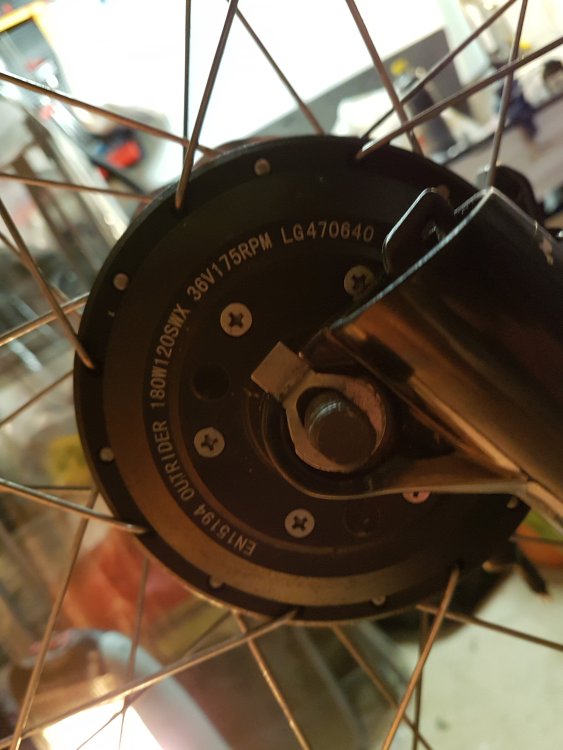
-
Controller internals

-
Test set up

-
Just done on a new thread D8ve, thanks
-
I thought it tidier to start a fresh thread, as my first post was full of my random guesses, and some very useful advice from Alan, Neal and D8ve in response to my random guesses. Following some more research/investigations, and a few hours of fiddling yesterday, I can add a few more facts which will hopefully be helpful in diagnosing the issue. I've uploaded a short video of the symptoms to Youtube, link = https://youtu.be/fqnNW_izFBk Basically, regardless of what I try, measure, connect, disconnect, the motor cuts in for one or two secs, the cuts out for ten secs, the cuts in for one-two secs etc etc. The DVM in the vid shows PCB-level DC voltage - interestingly you can see that something is still applying a load to the DC/battery supply even when the motor is not spinning, which implies that the controller is trying to turn the motor. I'm a (mechanical) engineer, hence I'm keen to understand the system (and the 'fault' rather than just spend money on new controller, now motor, or new battery at this stage) Summary of the facts (now that I've followed the advice of the knowledgeable people and actually checked things), in no particular order: I've now removed the wiring from the plastic trunking as it was hard to see what was connected, plus I want to turn this into a front-mounted, quick remove system so will tidy the wiring and rebag. I've carefully removed all of the silicone sealant that had been enthusiastically used to seal the wiring into the controller, and removed the PCB intact from the casing During tests I've measured the DC voltage of the NiMh battery - after sitting fully charged for a night, voltage measured at the external wiring was around 50V at no load, and 46V when the motor span. This seemed high for a 36V system - no load voltage on the mains chargers was >50V. After a few tests of the motor, DC voltage (now being measured at the PCB as per video was 36V at no load, dropping to ~32V when the motor kicks in. (And still bouncing even when the motor stops for ten seconds). So I don't seem to be hitting the 30V min voltage safety cutoff, but LSDZS/Lishui state that they use a 'soft' ramp-down when voltage drops towards min threshold, so maybe this is what's happening. Voltage does seem to drop significantly considering there is very little load with the bike off the ground - hopefully this does not mean that the battery is dying...? There is one red LED on the controller, which flashes continually on/off about once-per-second whenever the battery is connected, and this sequence never varies or stops I couldn't find any info online using the product IDs on the controller sticker, but the PCB is marked 'www.lsdzs.com' and their website shows at least one controller (LD-LS01-F..) that looks similar, but no user guides. There are a series of articles in the Services section that describe controller operation principles. I also can't find any details of the 'Outrider 180W 175rpm' hub motor online, but according to various posts, both the motor and controller are from 'Tongxin'. The motor is sensorless - i.e. it only has 3-pins in the connector. But there are three magnets glued to one end face of the hub, opposite side to the disk brake These magnets were sensed by a black 'hall effect' - i.e. a plastic cased, 3-wire sensor, that looks like a PAS sensor, but in a black case. I have had to tape this to the (suspension) forks ends on the new bike, as the original bracket was designed to mount on mud-guard fixings, which these forks don't have. The sensor is at most 1mm from the magnets as they rotate past. I still can't figure out what these magnets are for - as far as I know, a sensorless controller measures phase back-EMF to determine rotor position, it does not require an additional sensor inputs. However, I believe that sensorless motors cannot normally start from standstill, they need rotation and back-EMF to determine rotor position, whereas this system will spin-up from standstill, as per video If the three external hub magnets ARE used for motor control, then in theory the position of the black sensor needs to be set accurately, as otherwise the controller does not know where the sensor is relative to the axle/stator installation angle, as this varies with the angle of whichever fork is fitted, and therefore the original backet must be designed for the original Charge forks? Measuring signal voltage on the PAS, I saw (with my cheap DVM), the signal rise to ~4.6V whenever a magnet passed as I span the cranks The original black fork sensor did not show any measurable response to hub magnets passing, and the new sensor I bought and tried yesterday (which is actually a read-cased PAS sensor, but the only type I could buy), only registers a ~0.5V rise in signal when a magnet passes (with sensor <1mm from magnet) therefore possibly the new sensor is also faulty, or the circuit is faulty Regardless of what I try/connect/disconnect etc, the effects are always the same – as per video I just get intermittent hub rotation. I can’t test any of this on a rolling bike yet, as none of the brackets for the sensors fit my bike I did speak to Gibbs at Cytronx yesterday, but although he was helpful, he was not able to tell me much as the system set up is proprietary, and part of their business is the custom installation of kits so understandably he doesn’t want to give away their secrets. So my main question for now is – is the fork sensor used to control motor operation? I.e. have Cytronex invented their own external hall-effect sensor system, in conjunction with the original sensorless motor/controller? If so then I’ll continue trying to set that up correctly through trial-and-error angular position. If not, then is the controller, motor, or battery fried…? Thanks in advance as always! Adam
-
Tried all variations of polarity on both the crank magnets, and the hub magnets today and did various tests of voltage etc, I'll upload a short video if I can. I've stripped the controller down to measure DC voltage at PCB level etc. Basically symptoms still the same - I think at least that either the new hall sensor I bought and mounted next to the hub is faulty, or the circuitry in the controller. Any idea how to upload/share a short video?
-
Could that be a 'dead' phase?I thought so, based on some wiring diagrams I've seen online. Any ideas what the signal from the three external magnets are used for Neal?That's what I originally assumed, I'm not sure whether this motor is sensorless, or whether the three magnets on the hub give basic position signal, however the controller can't only the relative angle between the hub, and where the sensor is positioned on the frame so these must be used to give an indication of speed rather than true angular position? And also the shaft/stator could be at any angular position since the dropout slot angle will vary between forks.Understood Alan. Is the micro processor typically within the hub motor, or in the separate motor controller?Very useful, cheers NealThanks Alan and Neal for the advice. I don't have any technical specs for the motor Dave, however there are only three pins in the motor connector therefore if the controller is in charge of phase voltage control, then it must use the signal from three external magnets glued to the outside of the hub end-face, and detected by the external black sensor - which I assumed originally contained a hall effect as it is three wire. When i was first given the kit, I misunderstood that this black sensor was for a 'speedo' computer, hence ignored it and didn't notice that the three magnets had been knocked off the hub during my unsuccesful test spins in a vice. I later found two of the magnets and placed them temporarily in their original positions (I.e. within the glue 'wells'), but the third was lost hence for now I have taped on a small magnet that has approximately the same dimensions and strength. I have no info on the motor or controller so am making guesses about how the system works. Photo oh hub markings attached. Cheers
 Sorry, just read a reply to my other post, I'm guessing you mean the hall effects in the motor...? My hub only has three (power) wires to the controller, so must have electronics inside the hub.Thanks Alan, by hall effect do you mean the red crank sensor, or a hall effect in the motor? I'm guessing the motor. I just couldn't work out why the symptoms are so repeatable, unless the error resets after ten seconds, then trips again.Cheers Chris, I tried a new crank hall sensor tonight, with no real improvement, but hopefully neither if us is suffering battery problems.. good luck, AdamForgot to say, bike is mounted in a repair stand, so front wheel is in the air and this is happening with effectively zero load OK the front wheel. I'll try measuring battery voltage when the motor kicks in tomorrow night, in case the cells are weak and voltage is dropping below a minimum limit. Cheers, Adam


