Slimjim
Members
-
Joined
-
Last visited
Everything posted by Slimjim
-
That's a good price, £700 could buy me a kit with decent quality battery then, Thanks
-
Thanks Douglas that's very encouraging, and yes I have experience through my work of the interesting Chinese perspective on quality, although in recent years their products do seem to have improved significantly.
-
Ok thanks D8ve
-
Hello D8ve, Thanks for the quick response. www.psppower.com quotes 8kg for the 1000W Bafang, presumably including cranks, ring and display. The batteries I have seen look to have Samsung cells - thank you for pointing out that Dolphin refers to the case - therefore I need to be careful to check what cells and BMS are fitted. Re. 250W power - I mean the legal limit - i.e. 'maximum continuous power without overheating' - or words to that effect as per EN xxxxx standard that applies. Hence that would presumably mean output power, since input power will then be related to the electrical>mechanical efficiency of the system. Agreed on the complexity of measuring this - ideally you'd need something like a torque transducer and speed resolver - hence my point that I don't understand how police can check the max continuous power rating, as the will not carry a dyno with them....and if there are no stickers stating >250W, then nothing illegal. Actually the whole issue of max cont. power rating, without overheating, is complicated as that becomes a question of how high/low the manufacturer has set the thermal cut-out point (on PM motors generally to prevent magnet demag, or insulation and wiring damage afaik) Understood on the legal aspects - if I go TSDZ2mid-drive + torque sensing then I wouldn't automatically get a throttle input, so will always be pedalling at any speed - hence may not be an obvious contender to pull over. I'd prefer mid-drive at this stage as I have both a 26" full-sus Specialized Enduro that can take an absolute hammering, and a 27.5" GT hardtail that absolutely hammers my back off-road, so I'd like the option to swap the drive between them from month to month. FS has 25mm bolt-thru front hub, whilst H/T has normal QR hub (and both have different hydraulic brake disc diameters), so front-hub drive not practical. They also have different groupsets so rear cassettes are different hence rear hub drive not practical. Roads and trails round here have steep hills - torque-sensing would seem to work well offroad as it will respond to the natural pedal-stomping, whereas cadence sensors would (I think) require additional hand control of boost level to control torque at low speed and varying terrain. I've actually only tried a basic hub-driven cadence sensor city bike a year or two ago so couldn't tell you what make (quick demo at a visitor centre), but can remember that at low speed and tight bends, you had to be careful to co-ordinate pedalling, boost level and steering - a bit like a jet-ski, there's an extra dimension to monitor. Any advice/experience of particular sellers...? Thanks, Adam
-
I've been following a few threads on here, and Endless-sphere regarding the TSDZ2, but as is normal the threads develop and meander over time, and there are a lot of differing opinions, so I'm hoping for any useful recent advice. I'm a middle-aged mountain biker, recently moved to the foothills of the North Yorkshire moors (not too far from Sutton Bank), and not fit enough these days to make the most of the local trails, and roads. I've got an older FS Specialized with 26" wheels, and a newer, basic GT hardtail for road or light trail/winter duties - but due to work etc haven't got the legs these days to ride hard for more than an hour or so. Hence an easily swappable mid-drive kit seems ideal to offer the feeling of young legs and get me out for 20-30-40 miles with suitable effort, rather than using up my meagre leg endurance within an hour of trundling up steep hills. I might occasionally switch the kit between FS and HT, but I realise this could need some careful consideration of chainline on both bikes as they have standard 3x9-speed derailleur set up. I tried a Focus Bold yesterday with Shimano STEPS and Di2 - lovely bike but at >£4k not a practical purchase if I want to remain married - however it did convince me that I prefer torque-sensing to cadence sensing, as for low-speed/tail riding it seem much more natural. The 15mph cutout is a bit of a disappointment, but I'm aware of the legalities and that over-riding this is possible. Also, I could effectively buy two kits for less than one decent hardtail Ebike from Focus, Specialized etc, so fit the second to my wife's and get some family miles in. The TSDZ2 seems a good compromise of cost, power, weight and size (it will hang down/forwards from my bottom bracket, I'll fabricate an alu guard for off-roading), 500W would be double what I can put out for a short period, so in effect I'd have 2-3x my leg-only power, with my added input, and for a lot longer. 80Nm is reasonable (I assume this is actual gearbox output torque, not motor torque), as that's about 45kg of downforce at the pedal, and I only weigh 72kg The Bafang HD 1000W sounds great, but is heavy (8kg vs 3.6kg for motor), probably more power than I need, more likely to stress the battery, and more likely to get me pulled over by police...... I also have 70 mile round trip to work, could take back roads and have considered occasionally driving halfway, leaving the car and taking the bike out of the boot - this would offset the cost of the conversion a little as I only get 38-40mpg if I'm lucky. I could probably ride the full distance, but I'm wary of running two full recharges per commuting day as that is going to eat into battery lifetime. If anyone can advise on the following questions, I'd be grateful: 1. If I had a nominal budget of £800 (GBP) and wanted to purchase a full kit, with battery and warranty, which online or physical shop would be sensible? 2. Is this enough to buy the 500W motor kit, with H18 display (my handlebars are already cluttered with gear changers and hydraulic brakes, and I believe the H18 offers increased programming functionality plus options brake and throttle inputs), and a decent battery? I'm guessing 11 to 13Ah - I'd like say 20 miles+ of highest-power assistance off-road with hills and some sweating, 40 miles in medium assistance on road with a few hills 2.b. Are the Dolphin batteries good quality? 2.c What is a realistic number of battery charges before capacity drops/battery dies? Are the quoted figures related to a measurable reduction in battery charge capacity? Or related to terminal death of cells? 2.c What is the max voltage rating of the TSDZ2? I've read differing opinions of what happens if you exceed 48V 3. Is 500W the true continuous rating, and what is the peak power rating? 4. Can I set the system to 250W to be road legal, and easily swap to 500W? And vice-versa? Is tis basically achieved by adjusting the current and some simple math? 5. Regarding the UK 250W/15.Xmph legal limit: a. Has anyone ever been pulled over for breaching this limit - and what was the outcome? b. How do the police actually check - if the 500W sticker had fallen off my TSDZ2, do they climb on the bike and test it? Can I deny them the right? They could test speed but not measure power. c. Presumably programming a smaller wheel size will give a slightly higher 'legal speed' but the odo and speedo will be incorrect (not a problem if I'm running a separate computer/app) d. (I read that there are calls for the power output to be raised to 500W, but have not heard anything to say speed limit would be increased) Any advice greatly received, thanks, Adam
-
Hi Mike, unfortunately not very far since last update - despite having fully charged battery and checking all the wiring, I'm getting no response from the motor at all now. The controller is getting slightly warm so is receiving power, and throttle voltage range is normal. We're in the middle of packing up the house to move, and work has been too busy to borrow power supplies or test equipment, so I've boxed your kit back up the other day and will post it back this week rather than risk losing anything in the house move later this month. Apologies for hanging on to the kit for longer than expected, but thanks again for the loan. I'll find some time to investigate my kit further in a few weeks after we've moved, and let you know what I find. Cheers, Adam
-
Agreed with above, if motor is trying to turn wheel clockwise in above pictures, it can only do so by trying to turn the swingarm anti clockwise. Equal and opposite reactions. I'm assuming also that both ends of your hub axle have double flats, which sit into the inverted-U shaped dropouts on both side. This is how the hub transfers the reaction torque into the dropouts, then into the swingarm. I.e. a tension rod or cable would have to be above the swingarm to be in tension, which would be more difficult to achieve a suitable shape of vertical torque arm.
-
A steel rod is a neat, light solution if you can make it fit without having to kink it around the chain etc. However, I've just realised something- if you picture that the hub is trying to drive the wheel forwards, then it is in effect going to try to turn the bike in the opposite direction, I.e. lift your front wheel. Therefore a cable or thin rod won't resist that load as they will be under compression. How sturdy are your actual dropouts, can you post a photo? I'd be tempted by the second design, with torque arm. There are a few threads about the damage that can be done to dropouts from hub motor torque, however your installation would be no worse in that regard than any other hub motor retrofit. If your dropouts look like those on your drawings of the alu arm, and have the replaceable derailleur hanger, then the drive side one might allow you to bolt on a sturdier version that acts as torque reaction plate by holding the hub axle on that side? I still haven't managed to get my ex-Cytronix retrofit working, so no idea if I'm going to damage the dropouts on my Rockshox alu front lowers...
-
Cables are a very light weight method to resist loads, but again I would just consider that fact that the hub will try to apply torque to the dropouts (I assume the hub has the 'double flatted' axles that key into the dropouts, possibly in conjunction with steel keying devices). The dropouts will try to resist/react against this torque by applying a bending moment onto their joint into the carbon swingarm. That joint should have been designed to withstand heavy loads from the rear wheel impacts etc. But not necessarily the action of the dropout being twisted by the hub axle, around the centre line of the hub. Your cable sounds like it would only try to prevent the swingarm 'lengthening/flattening'? Which the swingarm is already designed to resist. The other issue with wires and cables is that they need to be pretensioned a certain degree to take up the stretch. Which is potentially loading your swingarm in the opposite direction - putting it under compression as the wire tries to pull the hub towards the pivot. Could you run the cable instead from the pivot, to the end of a torque arm that constrains the rotation of the hub? I may well be over complicating all this, and I could well be underestimating the strength of your swingarm. It's just worth bearing in mind that the benefit, and drawback of using composites is that the particular area of the component can be designed to handle specific loads, in specific directions, with specific laying off the carbon layers. And loads in unusual directions can prove an unplanned problem. By I'm just guessing. I'm impressed with your ingenious plans by the way, and that you haven't defaulted to just using a heavy and inelegant swingarm construction. I'd also try to find some novel way to handle the loads just as you have discussed, but then I'd probably never actually get round to finishing the design, and the thing would never get built or tested. Paralysis-by-analysis as they say. Good luck, post some photos as you progress.
-
I would just be careful about putting torque from the motor, or disc brake into the swing arm as it won't have been designed to handle torque.
-
Hmm I'll double check tomorrow night in case i was being dumb and measuring between positive and signal
-
There are various pad materials that have higher friction factor, might be worth a try after you've cleaned the current set up, and before spending money on a larger disc etc. They tend to wear out more quickly though....
-
If you carry on riding on worn bearings, is there a risk of the rotor rubbing on the stator with that amount of bearing play?
-
The locking nut has been glued on the outside, so I'll need to crack that off before I pull the guts out of the top half, intact.
-
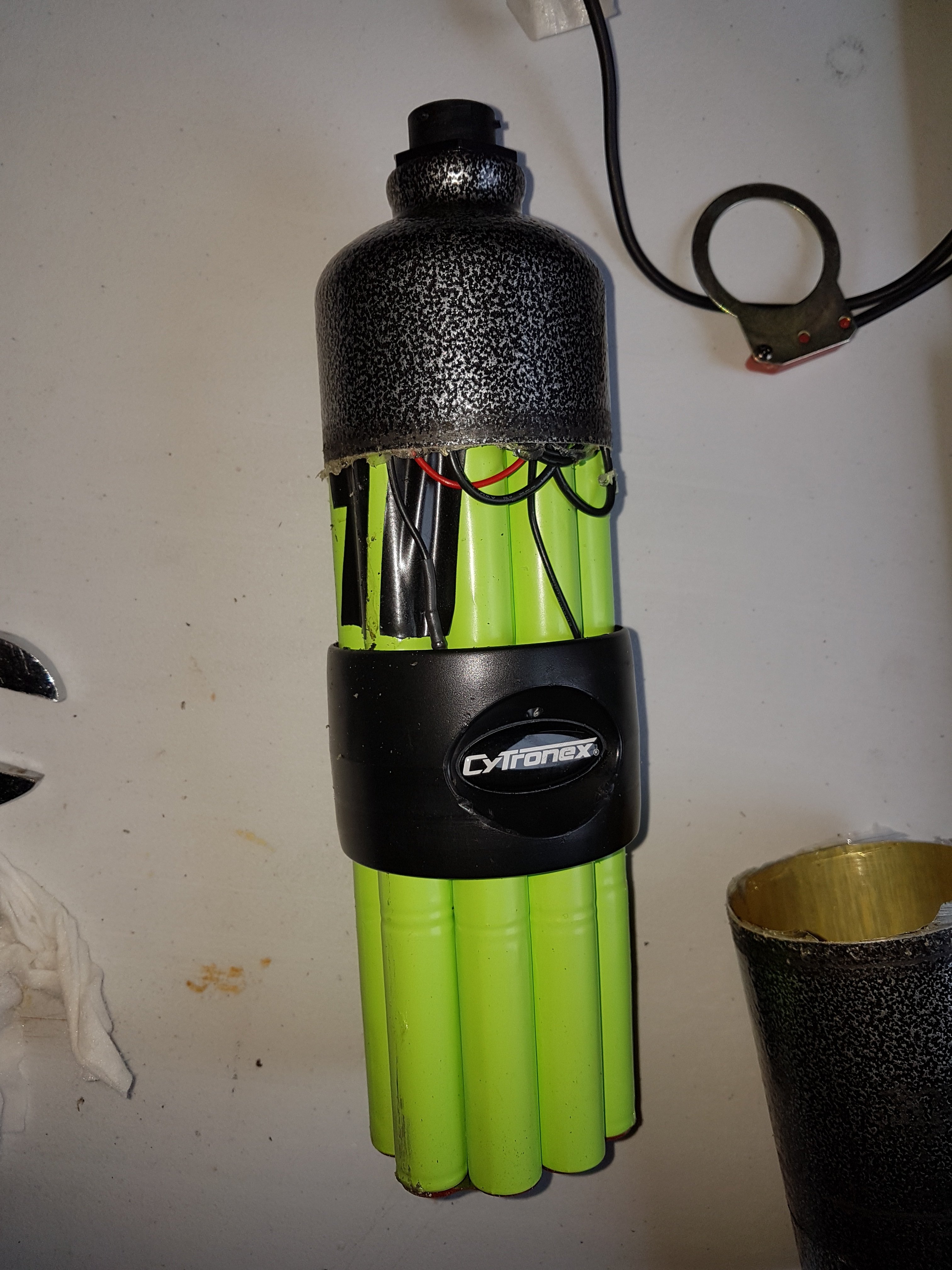
When I first picked up the system and charged the ni-mh battery until reported as full, I measured 46v open circuit on the battery, and 50v on the charger. To say that the motor has only run for the equivalent of one minute since then, it does seem to have plumneted... I've cracked the battery bottle halves open to have a look if I can measure cell or string voltage, but I'd probably have to do some surgery to get to any cell measurement points. However, the connector OK there bottle has something like twelve pins, which get commoned in the harness, When I measured all pins back to the 0v pin they were all at same voltage, but then I guess they're probably also all commoned to the same output voltage rail/wiring inside the battery?Finally got a chance to carry out some more tests today, apologies for hanging onto your loan kit Mike for longer than expected. Dave, with battery at about 36v, I've got 4.3v as the throttle. Throttle signal measures 3.5v when throttle is fully off, dropping to 0.7v at full throttle. At a signal level below about 3v (approx 1/3 twist) the motor kicks smoothly in either low, medium or high power setting. As before the motor spins for about 1/3 rev before cutting out. If i keep the throttle more then 1/3 open, the motor kicks repeatedly for 1/3 rev, then cuts out, then cuts in after 1-2secs for another 1/3 rev etc etc. Battery voltage (measured with a cheap DVM that is showing average voltage and I don't know what the refresh rate is), shows that voltage generally stays above 32v, but occasionally drops below 30v. However DVM reports voltage as being above 32v for most of the time, during which the motor is kicking on/off. I'm starting to suspect that the battery is weak, and the refresh rate on my DVM is to slow to show this. Does the SKU65 drop out immediately when voltage hits 30v, or does it have a soft ramp down from say 32v? I'm going to try to get to kit set up on a test bench at work and either use a scope to measure battery voltage with a suitable high frequency, or try pressing the kit from a bench top power supply. In the meantime I'll leave the battery on an overnight charge and try again tomorrow. Does that sound sensible? Cheers, AdamWhat equipment do you have to cut/machine/weld/design with?Are you going for this kind of swingarm shape?
 Following on from Top Drives comment, one of the reasons being that whilst plate would be easy to manufacture from, and plates are vertically stiff, they do not withstand twisting very well. But a tube is good at resisting twisting forces. So if you make a truss from tubes (round or square profile) , you can achieve the vertical stiffness from the structural layout of the tubes, and the torsional stiffness would be a combination of the structure, and the material (the tubes).Not a bad idea, water jet cut plates that tab together and some welding and you can incorporate all features. As per comment above, a swingarm made from even square section tubing, like the old Pace RC100 frames, would probably be stiffer but more time consuming. Look forward to seeing your plans develop.Oh, and if you only reinforce one arm of the swingarm, I'm guessing that the swingarm will tend to twist under load, add the un-reinforced arm will bend more.Possibly but as with any modifications to a structural component, if you make it significantly stiffer in one area, the stress around the edge of the reinforced zone increases, as the un-reinforced regions try to flex. I've only got limited experience with CF, I would taper-out the extra layers to gradually reduce their stiffness towards the edges. This helps to avoid 'stress risers/raisers'. And avoid running any new edges across the fibres, or directly along them. 45degrees would seem sensible. But I think a few more experienced CF-frame owners on here might point to the various photos in the web of what happens to a carbon frame it it cracks or suddenly fails..... And whilst you can do a fairly simple calculation of the load that the torque arm would apply at full motor torque, based on its length, there is always the risk of impact torque loads that would be significantly higher than peak motor torque. The main issue may well be the age of the carbon swingarm, as others have highlighted, and fit example whether there are any underlying cracks or she defects. Don't forget, if the hub motor is heavy, then when the swingarm bounces back say over a jump, the extra mass will have to be absorbed at the drop outs, and at the shock linkage as the shock suddenly reaches full extension. If you can adjust/reduce the rebound speed of the rear shock, you could reduce the increase in impact load. I'm just guessing at all of the above btw, I don't have enough specific experience for you to base any decisions on my ramblings! It's a nice, classic frame, be a shame to damage it.As a mountain biking mech engineer, I'd certainly be wary of fitting a rear motor hub to that frame. The bike has V-brakes therefore the dropouts on the rear swingarm were never intended/designed to withstand torque loads. Obviously a torque arm could help, but then if you're not careful, you would be placing a spot load onto the swing arm - and clamping around carbon fibre with a metal clamp would potentially put a 'sharp edge load' against the carbon's surface. Might lead to cracking when combined with the actual suspension loads and twisting of the arm. At the very least i would suggest bonding a reasonably large alu plate to the carbon, then clamping a swing arm against this. But even then I personally wouldn't risk it. Mid drive sounds the best compromise, then you can use the bike off road.Hi Mike and D8ve, sorry had a hectic few days so didn't get a chance to carry out any more tests. I'll measure throttle voltage etc tomorrow evening and report back, thanks for the advice and patience.