Leaderboard


Popular Content
Showing content with the highest reputation on 01/06/14 in all areas
-
Hi all, It's been ages since I was last on here. Been sorting out house stuff and new job and all that. Busy times! Anyway, I can honestly say that my non genuine battery is performing very well since I have been using it starting from mid March. It might actually be slightly better performing than the actual Bosch one. A true test will be after say, 8 -9 months of usage. I reckon it should be fine.3 points
-
The foam is designed to compress therefore allowing your head to decelerate over the entire thickness of the helmet as opposed to stopping instantly on the ground. http://www.helmets.org/general.htm3 points
-
i can speak from personal experience i have had 2 crashes on a bicycle which damaged my helmet beyond repair. i was left with nothing more than a bit of a sore head . i showed the damaged helmets to an a and e consultant friend who told me that the helmets are designed to take the impact with resulting effect that they are damaged beyond repair but better that than your head taking the impact. he told me after examining my helmets that i would definatatley end up in hospital if i hadn,t worn one. one of the problems apparently is people not wearing the helmets correctly or ill fitting i,m sure we have all seen them worn so far back on the head that foreheads are unprotected. to say that helmets are not effective under severe conditions may be true in the same way car seatbelts are not effective if you are involved in a head on collision with a lorry but that doesn,t mean you shouldn,t bother wearing a seat belt because in a lot of crashes they save lives. my son works at a bmx skatepark and has seen first hand the effect of not wearing a helmet as opposed to wearing one i know that a skatepark may be bit more dangerous than commuting but he has witnessed some bad head injuries with people just falling off at walking pace whilst not doing anything risky. i can,t see any justification for not wearing a helmet.3 points
-
Most of us carry a piece of pipe with us all the time in the form of the seat post. Dave.2 points
-
....or, as my old boss, a man from MacDuff, (which is about halfway from London to Reykjavic I believe,) used to say whenever I had trouble removing seized king pins or shackle pins from heavy goods vehicles as a young apprentice, 'Ye jist need a little mair purr..sivver..ince laddie!' I soon discovered that meant using a 14lb lump hammer instead of a 7lb one. A very wise, if unsubtle, old 'hielandman'! Tom2 points
-
2 pointsYep, Flecc your usage is like mine, a 60 km or less battery only range with a small genset for the occasional longer run. I wish they would do a small car with a small motor 25~30 kw and thus a small pack and generator which would hopefully make it a similar price to a normal small car.2 points
-
2 pointsthere are two believable sources regarding power consumption. 1. Bosch eco mode. This is the standard benchmark, practically quoted by most Bosch bike makers. speed: 20km, gradient: 0, personal: rider's weight: 70kgs, bike: 20kgs motor contributes 30% of whatever the rider puts in. Consumption: 300WH for 145km. From this base, one calulate the power consumption on throttle at 20km/h = 1.604 * 300 * 13 / (145 * 3) = 14.4 WH per mile at 12.5 mph for a 20kg bike + 70kg rider. 2. visit the e-bike emulator at ebike.ca There is a full chapter on the physics of power consumption. Essentially, the air resistance is the key factor which is proportional to the cube of the rider's speed. You can look at the load line - it's a bit parabolic in shape. The tool is useful to extrapolate the power consumption at different speed, gradient and rider's weight. You can also match the load to the motor and look up the maximum throttle speed, that's where the output of the motor is the same as power consumption. If the output of the motor is lesser than the load line (ie the power output plot is below the load line), the rider has to input the difference to reach the target speed. Roughly speaking, normal riders can produce between 100W to 200W, the Sport CD can produce about 400W at maximum throttle. Real world range depends very much on target speed, headwind and gradient. I can show how to calculate step by step from these parameters but it's diffcult to create a function for them. Allow 15WH for windy day, 10WH for perfect day. That translates to between 20 (windy day) to 30 miles (perfect day) for a full charge on your Sport CD with you pedalling leisurely (pink but not sweating).2 points
-
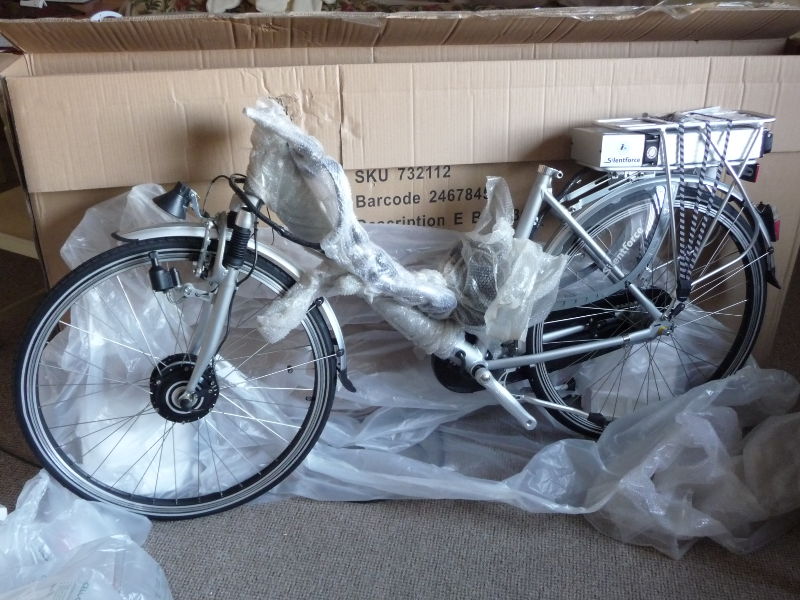
1 pointIt's £500 28" 25kg 36V 10Ah, 3 gears bicycle. I couldn't find any reviews before buying it, so I'd like to write a few words for those who consider buying it. It's too early for a review, I got it this week, so it's just first impression. Silent Force 0103 is sold in the UK by The Range, but only online. Seller's description and pictures (http://www.therange.co.uk/blog/power-your-ride-with-the-silent-force-electric-bike/) show how it looks like, but I'll add a few details. I've ordered it on Thursday, it was shipped on Friday and delivered Monday morning. Almost completely assembled. There is no assembling instruction, but you can see what needs to be done. Also front brake and shifter needed adjustment. Now the most crazy part: flashing pedals. I don't mind the flashing (it's yellowish), but I don't think it's worth the extra weight and friction. Three dynamos in one bike is too much, I'm going to replace them with normal pedals. On the handlebar, from the left: shifter, battery indicator with red LEDs, normal cyclocomputer, red switch for PAS and throttle in the right grip. The front light is rather poor, extra flashlight (for a few quids on ebay) should make riding after dark more comfortable. I'm also considering puncture-resistant tires and different saddle. I'm happy with everything else. The motor in the front wheel can be heard, but I suppose it's not different than in other e-bikes. The speed is limited to 25km/h. The steepest slope on my way to work is about 8%. The bike easily goes up, 18km/h with no pedaling (only moving crank to keep PAS on). The chain is completely covered. And a solid kickstand. A bit too high, it keeps one wheel a few inches above the ground. After going 4 times to work and back (86km total) I'm very happy with this bike. It changed my daily commute.



 1 point
 -
I think it is a good upgrade for ebike riders. For this price I wont complain. http://www.merlincycles.com/cane-creek-thudbuster-seatpost-70095.html p.s. it is 31.6mm so need to check your seatpost diameter Pat1 point
-
ebikereviews.com.au have a new segment which they call "Interview with an Ebike Celebrity." They kick off the segment with an interview with Maurice Wells of Glow Worm Bicycles in Sydney. Glow Worm Bicycles are the Australian distributor for eZee bikes in Australia, as well as sellers of other brands of electric and non-electric bikes.. An interesting insight to a major Australian player in the eBike world. Andrew1 point
-
- - - - - you can also use a heel stamped onto the short end to multiply the force, the time honoured method with car wheel braces to release grime-locked nuts.1 point
-
If torque is a problem with short spanners, you can extend the handle by slipping a piece of pipe over the end of the spanner (maybe difficult with a double ended spanner, but not impossible). You could carry the piece of pipe in your toolkit with your short spanners. Don't forget to include a piece of rope and a candelabra:D (Just in case you don't have a cluedo)1 point
-
hi everyone I have been in touch with a lady at staffs county council about classes in cycle maintenance ,she is very enthusiastic about this ,and if we can get enough people interested would be looking to start a class . this would be a basic class ,ideal for some one new to biking like myself . if you are interested or know some one who might benefit from this please send me a private message ,and I will send you the contact details,or if its ok with the mods I can put it up on the forum thanks1 point
-
1 pointThanks Dave, that was very helpful. @ Trex: I am open to suggestions. As I wrote before I have no experience with e-bikes. But I think that the important issue here is that I only need the extra power for the hilly parts of my short commuting. I intend to use this bike mostly without the electric power. In that light I am not sure that a crank drive is best for me as I lose my front gear set. The bottle battery (after Dave's feedback) seems the better choice.1 point
-
Let me put some numbers to this: a = ((v1*v1) - (v0*v0)) / 2d Say you are travelling at 20 MPH v0 = 9 m/s d = 2 mm of foam (say for a cycle helmet) a = 20250 or 2025G (most likely fatal even though the G force is for a very short duration) d = 50 mm of foam (motorcycle helmet) a = 810 or 81G (most likely survivable) I hope this illustrates that it is mainly about the value of (d) and a bicycle helmet gives you very little. As TREF says above, these bike helmet need a re-think. I believe that the way forward is a lightweight aluminium honeycomb outer shell which distorts on impact (giving a greater value of (d). The current polystyrene ones are a con (very little (d)).1 point
-
and to follow on from this point it becomes hard to understand why the paper I linked to before concluded in part if the effectiveness of helmets clearly not effective... In the 2 m (6.3 m/s) drops, the middle of our drop height range, the helmet reduced peak accelerations from 824 g (unhelmeted) to 181 g (helmeted) and HIC was reduced from 9667 (unhelmeted) to 1250 (helmeted). At realistic impact speeds of 5.4 m/s (1.5 m drop) and 6.3 m/s (2.0 m drop), bicycle helmets changed the probability of severe brain injury from extremely likely (99.9% risk at both 5.4 and 6.3 m/s) to unlikely (9.3% and 30.6% risk at 1.5 m and 2.0 m drops respectively). These biomechanical results for acceleration and HIC, and the corresponding results for reduced risk of severe brain injury show that contemporary bicycle helmets are highly effective at reducing head injury metrics and the risk for severe brain injury in head impacts characteristic of bicycle crashes. (my emphasis) The journal which the paper is published in is what is known as a A* journal, i.e., highest ranked group of journals in the world in its subject area. You would think therefore that the editorial board and the peer reviewers would have a clue. The paper for anyone interested is: Cripton, P. A., Dressler, D. M., Stuart, C. A., Dennison, D. R. (2014). Bicycle helmets are highly effective at preventing head injury during head impact: Head-form accelerations and injury criteria for helmeted and unhelmeted impacts. Accident Analysis and Prevention, 70, 1-7. Then comes into question all the science behind the standards for helmet design for both motor cyclists and cyclists ... seems a lot of people must have got that wrong which simply does not seem logical. Andrew1 point
-
For those interested in being informed, there is a monograph published in 2010 which whilst tending to focus on mandatory helmet laws, also looks at the research to 2010 on the effectiveness of helmets and in particular hospital data. If nothing else it is a good starting point to the literature in the area. Haworth, N., Schraman, A., King, M. & Steinhardt, D. (2010). Bicycle helmets research.CARRS-Q Monograph Series – Monograph 5. Kelvin Grove, Qld: Queensland University of Technology Centre for Accident Research & Road Safety – Queensland. Andrew1 point
-
I can point you in the direction of Newtonian Mechanics and the laws of physics: For example, a = ((v1*v1) - (v0*v0)) / 2d Where: a = acceleration (a high value of (a) on the brain is what does the damage) v1 = final velocity (ie 0 when the head has come to rest) V0 = initial velocity (ie the velocity the head is travelling just prior to it or the helmet striking a solid immovable object such as the ground or piece of street furniture.) d = the distance over which the head stops. This will be the amount of compression in the helmet foam. As you can see, if (d) is small (ie very little compression) then (a) is high which is dangerous. With a motorcycle helmet, (d) is many times the value of that of a bicycle helmet because it has much thicker padding and this is why it offers a sensible level of protection. A bicycle helmet is usually constructed from polystyrene which has very little compressibility. On the inside, you usually find thin strips of sponge which again hardly compress any distance before your skull is hard up against the incompressible shell of the helmet. The sponge is mainly there so that the shell sits nicely on your head, nothing to do with protection. Sometimes the bicycle helmet will fracture and this may have the effect of slightly increasing (d) in the equation of motion quoted above, but no where near to the levels of (d) found in a motorcycle helmet. The above is simple Newtonian Mechanics and requires no further reference or proof. The only point open for discussion is the relative values of (d) between wearing a helmet and not wearing one. My position is that (d) is about the same in the two cases. I do accept that a bicycle helmet offers some protection agains abrasions.1 point
-
1 pointThanks trex. Those mileage figures seem about the sort I would hope for. So if I did crank on I expect I could up them by a fair bit if I needed to go a bit further. Pink but not sweating sounds good but it doesn't conjure up images of cycling to me.... The Bosch figures on the flat with the rider doing seventy percent of the work to get 145km on 300wh is quite impressive really. Of course that would imply a still day but I wonder if it really takes account of drag? Even at 20kph on a still day unstreamlined bodies have a fair bit of drag depending on seating and handlebar position. I must admit I never liked the MB type handlebars much when I did buy one. I vastly prefer to ride with my palms on the top of the brake/gear levers of road bike bars, and you can always drop down in the wind with them. You can get better leverage for climbing with road bars too. I'll look at the site you recommend. I expect I'll get a feel for how far I can go on a leisurely ride and how far I can when I want a good workout after a bit. I live on a steep hill and I'd like to leave a bit in reserve to help me up that on the way home though so wouldn't want to run completely out of power at the last....1 point
-
Can you point to any credible research that support this? It does not from what I can gather come close to reflecting the Australian Standard on bicycle helmets (or motor cycle helmets) nor does it reflect the findings of research such as: Cripton, P. A., Dressler, D. M., Stuart, C. A., Dennison, D. R. (2014). Bicycle helmets are highly effective at preventing head injury during head impact: Head-form accelerations and injury criteria for helmeted and unhelmeted impacts. Accident Analysis and Prevention, 70, 1-7. so very interested in what evidence you have to support your view. Thanks Andrew1 point
-
1 point
-
1 pointDifferent pedaling styles put pressure on pedals in a different ways. Cyclist that pedal with their instep over the pedal axle tend to put all of the pressure to the end furtherest away from the crank because of the way your foot and shoe is built. Cyclist that pedal with the wide part of the front of their foot put more pressure on the pedal closer to the crank. This greatly reduces the stress on the pedal shaft. Having said that, a good quality pice of kit should never break like that.1 point
-
Is it the crossbar you can't get your leg over (ooo, er) or the saddle? If it's the latter, a dropper seatpost might be a solution. Mountain bikers use them to get the saddle out of the way when they are bouncing over tree roots and boulders. You could try putting the saddle right down on your bike just to see if you can get on it any easier. This site has a few pics of mostly dearer droppers, but there are several makers so there's no need to pay hundreds. http://www.dropperseatpost.com/1 point
-
1 pointMost of my journeys are short and fairly local so with some larger battery plug-in hybrids, most of the mileage would be all-electric from the mains charges, the i.c. engine hardly ever even cutting in at all. I could envisage some years when the engine would only start a few times, making it effectively an electric car! And that would also be true for a high proportion of drivers. The crazy additional cost of an all-electric car only provides around 40 or 50 additional miles range, not needed for local journeys but not enough for most longer ones. It really does make them pointless.1 point
-
1 pointPHEVs like the Mitsubishi Outlander above are primarily ICE vehicles, with bolt on batteries that can be charged by the ICE in 30 minutes while you continue driving. The car weighs 1810kg, average weight for a similar size car, has a 10 gallon tank and gives you an extended range about 800 miles, twice that of an average car. So if the battery dies, you can still use the car, the fuel economy won't be as good but it's not a write-off after 5 years if it were primarily electric. (crossed with flecc's) There is no way the grid can support pure electric cars. For the next 20 years, PHEV is the way to go. The battery capacity will expand, extending economy etc.1 point