Sturmey
Members
-
Joined
-
Last visited
Everything posted by Sturmey
-
I find it very difficult with a cadence only system to even get any movement on the pedals if I stop on an incline (or sometimes even in traffic/crossing the road) in a high gear and need to get going again. For this reason,I cycle nearly all the time with the throttle temporarily enabled. I find it quicker and safer. It reverts back to a walk assist function when I turn off the bike. I pedal most of the time. Its not that I'm lazy, I just find it safer.
-
I agree in that I get tired using the torque sensor. I live within 7 miles of a mountain bike trail center with over 60 miles of offroad single track. Almost all the ebikes I see use torque sensor bikes. I would be an exception in terms of using a cadence sensor hub with full throttle, which strictly speaking is illegal but I like it. But there is no way I can see a cadence sensor only bike as suitable for mountain bike climbs without a full throttle as the cadence sensor bike can stall dangerously on a climb. Its here where I think the torque sensor bikes outshine the cadence sensor. To be honest and legal, I cant see how a cadence sensor setup could be suitable for any kind of serious mountain bike trail use without the additional use of an unrestricted throttle.
-
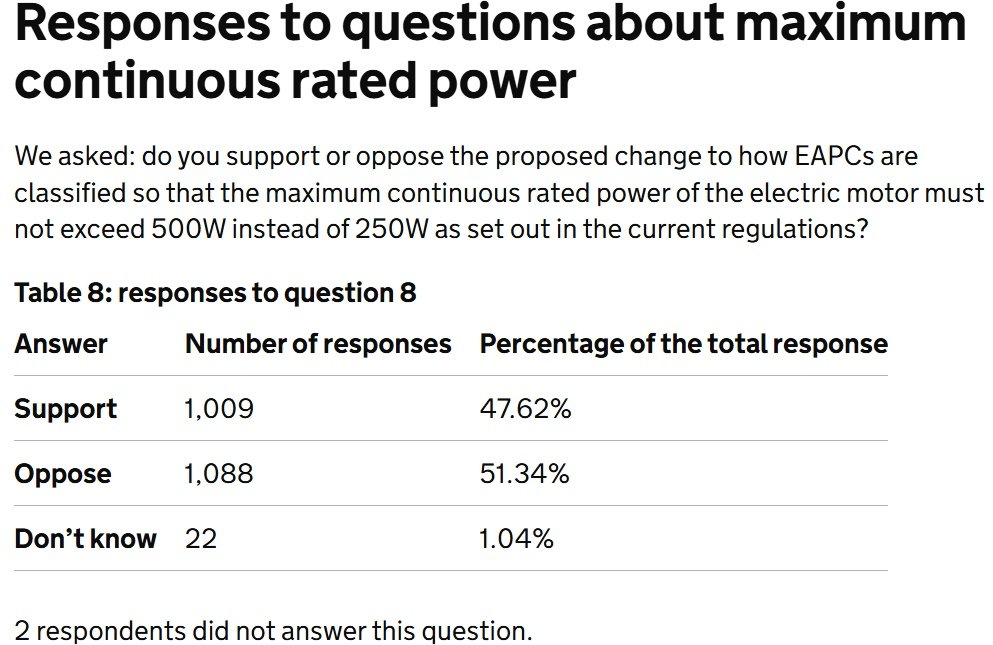
There was a survey done where 47% of respondents seem to support the idea of an increase in power level as below. I would tend to agree with this and with the original poster. I live in a hilly area. Proposed changes to legislation for electrically assisted pedal cycles – outcome - GOV.UK
-
I tend to agree with you. The root of the word 'skept' goes back to 'examine' or 'consider' or the ancient's use to say 'open to inquiry'. The sceptic was considered as holding no strong beliefs as such as everything is open to inquiry. The sceptic is often seen as the opposite to the dogmatist who has there mind made up (strong beliefs). So the sceptic, having no strong beliefs considers everything open to inquiry whereas the conspiracy theorist has a strong dogmatic belief that needs no further inquiry . Of course, the word has been twisted since but the true spirit of scepticism is one of keeping an open mind. MembeanWord Root: skept (Root)The word part "skept" is a root that means "examine, consider".
-
Some of the Phylion/Joycube batteries with 5 pin plugs are as below. The battery may not charge with a two wire charger unless you loop 4 & 5 as below,which is not safe as you are shorting out some of the safety features .

-
He did not give the batch number. On Google Chrome on my old computer, you can right click to open in incognito window, accepts cookies if you have to and right click for translate. The cookies should clear when leaving the tab.
-
Sorry to hear about your Kt controller problem with your AKM motor. This appears to be a known problem and is discussed in the German form with one supplier claiming that he has a batch of Kt controller all suffering from this bug. Link is below. You need Google translate . . https://www.pedelecforum.de/forum/index.php?threads/hysterese-kt-controller-mit-akm100sx.115911/

-
If you are going off road, I would enable full throttle and enjoy it. The throttle is especially useful for hill starts, tricky maneuvering/switchbacks/drops where its useful to be able to put your feet on the ground, with the saddle lowered. Its also more comfortable going over rough ground with a throttle as you dont have to pedal and can use your legs to take some weight off the saddle. Also I notice that on some bikes with KT controllers, the power tapers down at PAS 5 earlier than with the throttle and using the throttle gives some extra power at higher speed.(can be seen with the LCD3). I dont know if this is peculiar to my case but its something that you can try by enabling full throttle.
-
Check the brake levers as they often get damaged in a fall and there is usually a little sensors built in to them so the motor cuts off when you pull the brake. If you suspect damage, you can usually trace the electrical cable and just plug them out. There may be some indication or symbol on the lcd display telling you the brake is pulled.
-
I see pswpower have a rear Bafang cassette kit, 65nm, 48v,Kt20A, 27.5 inch from Germany for £165 +7 delivered. It looks good. The G020 I think is a similar type (newer version) of motor to the older Bafang BPM (5:1 etc) but I cant tell you any more. (26 & 29 and front version also available) I wonder would it be a good buy? https://www.pswpower.com/products/mxus-electric-bike-conversion-kit-wheel-hub-motor-36v-48v-1000w-500w-250w-26-28-700c-rear-front-drive-engine-ebike-kit-xf07-xf08-xf08c-xf15f-xf15r-341
-
7 pin cable seems unusual to me. What type of plug?
-
I read the Glascow central station fire is alleged to have started in the Vape shop. I hope the Vape lithium batteries are not to blame.
-
Is your hub motor a front or a rear, and does the cable come out of the axle center ? If the cable comes out of the axle center, then beware that the nut and washers are only barely big enough to allow the existing julet plug to pass through, so if you make a wider shrink wrapped joint, you need to make sure that the nuts/washers are on the axle and your spacing is right before you join the cable. (unless you can make the joint so narrow that the nut can pass over it) If your hub is a rear hub with the cable existing thru the middle of the axle on the drive side, then be aware that if you need to change the cassette/freewheel, it may have to pass down over the trapped nut and washers as well as the shrink wrapped joint, so I would suggest not using large washers and possibly grinding down the nut or fitting a smaller plain 17mm wheel nut (outer socket size) if can be found and this should allow the cassette lockring removal tool to fit as well.
-
The pins are plated with possibly gold. Once the plating is damaged/burnt on the male motor plug pin, it may heat at the point of contact with the female pin and this could explain why you keep burning out the connector on the same pin of your replacement cables. Ideally then, you need to replace both connectors but its a tricky job to replace the motor cable. I think what I would do is, leaving the wheel connected and firmly on the bike with all its nuts and washers fitted, strip back the black outer sheet of the cables on both sides of the connector (without cutting or damage to the coloured wires) and just solder in a single wire to bridge across the faulty connector pin. Then I would tape up the whole job and make it waterproof. (I still have a roll of Denso Tape from my days with the phone company). Before doing this, you will need to confirm and double check with a meter what colour the cable wire is that is connected to the damaged pin. This should work but there are some drawbacks such as if you have to replace the freewheel or cassette you may have to undo the connection. You can replace the tyre/tube without touching the cable but its a little tricky. You turn bike upside down, remove tyre/tube from rim. Then open wheel nuts, lift wheel a few inches from dropouts, take out tube/tyre, slip in new tube/tyre, put back wheel in dropouts and tighten nuts, then mount tube/tyre on rim. Alternatively, you can disconnect the cable at controller end. Incidentally, I nearly always change tubes/tyres without opening the motor cable as the 'drip loop' gives enough slack and I have came across motor connectors that wont pull apart because the pins have welded into one another, so they are best left alone..
-
The one thing often not taking into consideration with inductors is that there are two current paths, the 'ON' path and the 'OFF' path. For example, to illustrate this, take the simple induction coil that is traditionally fitted to say a classic motorcycle/car petrol engine and is controlled by a set of contact points. When the points close, battery current energises the magnetic core of the induction coil and energy is stored. When the points open there is a collapse of the magnetic field in the inductor which causes a surge of energy to be released and create the spark. The important point here is interesting things happens during the battery ‘off’ period when it comes to inductors. This induction coil principle is exploited with buck converters and there is no shortage of explanation on line that can explain the principle of buck converters. The ebike motor itself is a very large inductor and the motor coil inductance is successfully used to reduce the battery voltage down and increase the motor current well over and above the battery current. When it comes to our ebike motor similar things occurs when the motor current is limited by pulse width modulation. So taking Grins example, say I have a 48v setup with an unrestricted motor that has maximum no load speed is 40km/hr at 48v. The controller is set to limit the battery current to 10 amps. So I am climbing a hill, the speed say drops to 20 km/hr so my motor back EMF drops to 24v. Although the 48V will be presented pulsed to the motor, because the back EMF is 24v, the extra 24V will be absorbed as magnetic energy in the induction of the motor. (voltage will also be lost in the copper resistance as inefficiency but I will leave this out of the discussion). In this scenario then the mosfet’s will be acting like the motorcycle contact points pulsing about 50% on and 50% off . The 50% ‘ON’ time. So if we look at the actual currents, although the battery is supplying 10 amps average, there is actually 20 amps at 48v current going to the motor during the 'ON' time and that's for 50% of the total time. However, of the 48v is going to the motor, only 24v is actually been used to power the motor, the remaining 24V is been absorbed as inductive energy. The 50% ‘OFF’time. This is the same as the period with the motorcycle example above where the points open and the magnetic energy stored in the induction coil winding is released as a spark. With the ebike controller, the top 3 mosfets on the positive side are firmly switched off so no battery current flows. But the bottom 3 mosfets carry on their business and control the energy that is now released by the induction in the windings as a circulating current through the lower mosfet's body diodes. The actual current paths in the controller are illustrated below. If there were no inefficiencies in this particular scenario, this energy would be the same as the stored energy and another 20 amps current would flow as freewheel current. (Sometimes called flyback or flywheel current). This then explains why the motor current can be double (or more) the battery current. i.e. Motor Current = Battery Current + Freewheel/flyback (induced) current. PS There is also a second argument and more theoretical explanation (Kirchoffs second law) as to why something always has to fill the gap between back emf of the motor and the emf of the battery .

-
Good article below by Grin explaining how the motors and controller acts as a buck converter. https://ebikes.ca/resources/getting-started/ebikes-parts-explained.html
-
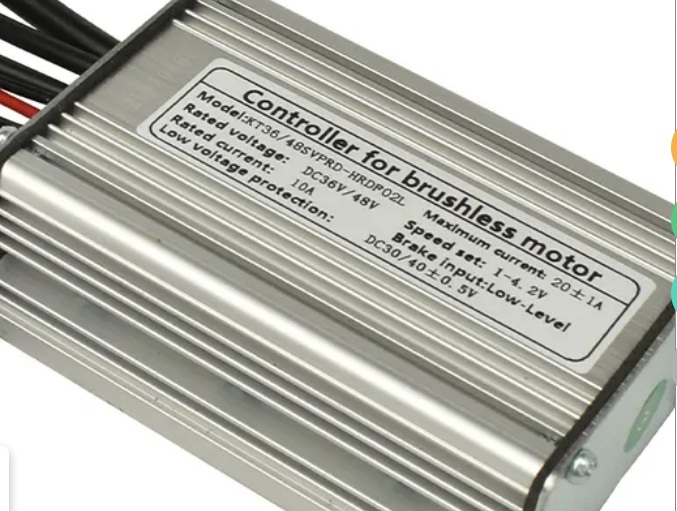
Below photo of controller I use on the motor. Its 6 mosfet but bigger that the normal 15 amp, so should help cooling. It covers all my options i.e 15 amp max at 48v or 20 amp max at 36v. The voltage automatically switches. I have only one 48v battery (630W) but I use to bring a small 20 cell 250w 36v as a reserve battery on longer runs when I used it at 48v. I had no problem switching to the 36v reserve battery the occasional time I had to do it.
-
Here is how I calculated the rpm for my motor.. I am ignoring the quoted rpm rating and trying to work it out from first principles so to speak. I am not sure how reliable it is. But many of the legal type 25 Km/hr motors I have come across seem to generally do something like 32-35 Km/hr at full charge with the wheel of the ground and the akm 100 doesn't appear that much different in this respect. 26 inch wheel =660mm diameter = (660 X 3.14)= 2070mm, wheel circumference=2.07m At 33 km/hr, the wheel makes 33000/2.07 = 15942 rev/hr = 15942/60 rpm = 265.7 rpm at battery voltage reading on LCD5 when wheel was turning (40.5v) The bike parallel batteries have schottky diodes and the Lcd 5 was reading about 40.5v when wheel was turning, so allowing for this, we have 265.7 rpm at 40.5v = (265.7 X 36/40.5) rpm at 36v = 236 rpm at 36V PS As a postscript to above, its interesting to wonder where does the number '201' come from in quoting the rpm in this case. Is the 201 rpm in this case refering to the non loaded motor speed or the loaded speed that it is intended to use the motor at. I notice that sometimes Bafang quote both speeds whereas mxus tend to quote the higher non loaded motor speed. I think akm is quoting the lower intended loaded working speed in this case as '201'. Why I think that this is the case is because '201 rpm' is an important number as it represents the actual rpm of a 26 inch wheel at 25Km/hour and can be derived by dividing 25Km/hr by the circumference of the 26 inch wheel and divided by 60 (to convert hours to minutes) i.e 25000/2.07 =12077 and 12077/60 = 201 rpm. I think this has been discussed on ES on the difference between loaded and unload speeds.For example, in the old discussion below, motomech quotes the '201' Q100 as 230rpm and I am similarly inclined to see the AKM 100 '201' as a 230-240 rpm motor unloaded and this figure would be better to use when comparing the motor to say a mxus motor.. https://endless-sphere.com/sphere/threads/q100-and-q128-motor-speed-questions.47042/#post-689761
-
T The retailer (pswpower) recommended on their website the 20amp sinewave controller at 36v and it works well with this. With any low rpm motor at 36v, I have ever used, you can always set the pas to a high level, e.g. PAS 4 (or even PAS 5 in some cases) and ride around all day on it, because the back emf will limit the current anyhow. So with the akm at 36v, the current starts to taper down from about 20-23 km/hr onwards on torque simulation. Things are different with this same motor at 48V. The motor will continue to consume current up to around 35 km/hr before the current tapers back so you need to reduce the pas setting to stop the motor from going too fast or overheating. So when I am riding in my normal undulation countryside at 48v, I have to change up the pas level climbing hills and change back down on the level bits. Of course, there is a big temptation with 48v to just continue riding at high speed but the motor gets very hot and range reduces at continuous high speed. This is not an issue at 36v as the motor back emf automatically reduces the current once up to speed for me.(This is a bit subjective I suppose but it works for my style of riding and I find the LCD5 very difficult to change pas levels with gloves in the winter.) I am not sure exactly what the problem is with the older controller. It works perfectly with its original motor. The screeching and loss of power at say starting off from stationary appears similar to a faulty/slipping clutch. The AKM 100 is an internal fast running 'inner rotor' motor. There has been reports of what looks like mechanical problems with these motors that have been solved by updating the controller. But anyhow, in my case I tried it with the older square wave controller first and when it did not work well (motor screeching,power loss) I tried it with the newer sinewave controller and it worked well. But anyhow, perhaps with a bit of luck, your older controller will work anyway. But if there is any weird problems, suspect the controller.
-
I took the front motor bike out for a run today. Its fitted with a AKM100sx f2 motor . It was marked as a 201 rpm motor but I think its more closer to 240rpm. (The P1 setting is 202) Anyhow, with the battery charged with a 26 inch wheel unrestricted, it gives 33km/hr at full throttle with the wheel of the ground. At the end of the ride with the battery nearly empty (34V) I get about 28 Km/hr with the wheel of the ground test. In practice then with this motor, I find that there is noticeable assistance perhaps up to 30 km/hr when fully charged but this reduces down to about 24 Km/hr as the battery empties. I tried this motor with a 48v battery during the summer but the motor and controller heats up very quickly. Also I found it tedious to ride as I had to continuously change the PAS settings. (At 36v, the motors power tapers down naturally when heading towards 25Km/hr so for me its a more relaxing ride). The only other thing I would like to report is that my motor likes the newer KT sine wave controllers.(36/48v 20amp) I tried the motor originally with the 36v15 amp KT square wave controllers that came with the older Yosepower kits but the motor intermittently gave a very loud screech and looses power to the wheel.( It was like driving a car with a slipping clutch)
-
Article below if its any help. https://road.cc/ebiketips/content/advice/advice/buying-and-riding-an-s-pedelec-in-the-uk-1637
-
Re above and looking at photos, some of your cells are at 4.4 volts which is very high imo. Any cells I ever bought were partially charged at 3.5v and its much safer to assemble at this low voltage. Your charger should normally not go above 42v for 10s. https://qnovo.com/blogs/104-perils-4-4-volts
-
On one bike I fitted a 7 speed freewheel and fitted the tabbed anti rotation washer on the outside on the freewheel side. This reduces the requirement from 139mm to 135mm on the freewheel version so I think I got away without widening the frame. With the cassette version on a different bike, I had a spare 3mm axle spacer nut from an old motor. I think I replaced the 5mm spacer nut on the disk side with the 3mm nut and the 8mm nut on the cassette side with the 5mm nut I took off, reducing the overall axle width by 5mm. I am using a 8 speed cassette. I had to spring the frame apart slightly to fit the wheel. This made fitting the wheel difficult so I permanently spread the frame apart afterwards. (The bike was a 10 year old Barracuda that I got very cheap as It had a broken rear wheel so it was ideal for a rear wheel conversion). I also had to deepen the dropouts in both cases. I am not sure if I would be happy about converting a new bike as its very easy to leave marks.

-
Good photos. The windings can be seen through the holes in the stator which can be turned. Any burnt motors I have ever come across had a strong smell. Your motor (and clutch) looks very similar to the mxus xf07 motors and the older Yosepower motors. I counted your outer gear which I think has 93 teeth so your motor looks like the regular 93 outer, 21 steel inner gear with 36 T planetary gears. There is a mathematical relationship with the gears. 21 + (2 X 36) = 93. The reduction ratio (outer: inner) looks like 93:21 which works out at approx 4.4. You probably have 20 magnets on the stator so if this is the case, you set P1 in the KT controller to 88 (20 X 4.4) although for some reason 87 is often recommend.
-
I bought a second hand 'returned' motor lately. I done all the usual electrical tests and inspections but I also opened the six screws and opened the motor to inspect the winding and internal gears. It only took a few minutes and all was perfect, but my thinking was that it would be a waste of time to lace a rim to the hub if I was not sure that the winding was not burned.